Friday, December 22, 2017

Brett Halliday - Marked for Murder

Shayne's wide nostrils flared and he felt a prickling in the back of his neck. He pushed the bedroom door wide open, turned on the light, and looked somberly down at the corpse of a young girl lying half off the bed. She wore a pair of black net stockings, the tops rolled above her knees. The rest of her slim young body was nude. She lay on her stomach with her right arm and leg trailing off the bed, her left leg stretched straight and taut with the toes pointing toward the footboard. Her left arm encircled a pillow, and there was dried blood on the pillow and on the sheet beside her breast.


Dell Books June 1959 - Cover by Robert McGinnis

Okay, I'm a sucker for paperback covers featuring beautiful women, especially ones painted by Robert McGinnis. There are tons of Mike Shayne novels with McGinnis covers, and I have a couple others on my bookshelf. In the 60's and 70's the Shayne covers were often photos of hot babes, in various states of undress, typically wielding a gun. These were never as cool as the McGinnis covers, for obvious reasons. As far as the Mike Shayne novels themselves go, they're perfectly serviceable reading if you're in the mood for a private eye novel. I've only read a few and the things I take away from them is that for a private eye, Mike Shayne is as famous as your average celebrity, and he drinks a shit-ton of brandy. Most P.I.'s drink bourbon, or scotch. but it's brandy for our pal Shayne. And he's hot with the ladies too. He's also smarter than the cops, particularly Peter Painter, the Miami Beach police chief. But all in all, he's a decent Joe to have in your corner.

This is an early Mike Shayne mystery, going clear back to 1945. By then he was famous enough to already star in a handful of films from 20th Century Fox. He'd also star in radio and TV, and scads of more novels. I noticed that there are a lot of them available on Kindle, but I prefer the old paperbacks, for obvious reasons. Anyway, this is, I believe, the 12th novel in the series, and written by Davis Dresser. Ghost writers under the Brett Halliday name would take over the later novels.

In this one, Mike Shayne is called back from New Orleans to go after whoever it was that shot his reporter pal, Timothy Rourke. Rourke had been hot on the story of a series of murders where the victims had all recently struck it big at various casinos in Miami Beach. All of the casinos are run by the syndicate, in particular a hood named Brenner. Each of the victims was found with a .32 slug in their heart only hours after being seen in the company of a hot blonde dish at the casino. Rourke's crusade has everyone pissed off at him, the cops, Brenner, and Rourke's boss Walter Bronson. Rourke is warned off the story and given a beating by Brenner's thugs, and is found a few hours later in his apartment, near death from, you guessed it, a bullet to the chest. And wouldn't you know it, the last person seen leaving his apartment was a hot blonde babe!

This novel was a fast read, well-paced and with enough twists and angles to never get boring. And, as Shayne himself says a more than a few times, "There are too many blondes!" Yeah...I don't know if you can ever have too many blondes around. Just as long as none of them are packing a gat, I'm okay with it.


Sunday, December 17, 2017

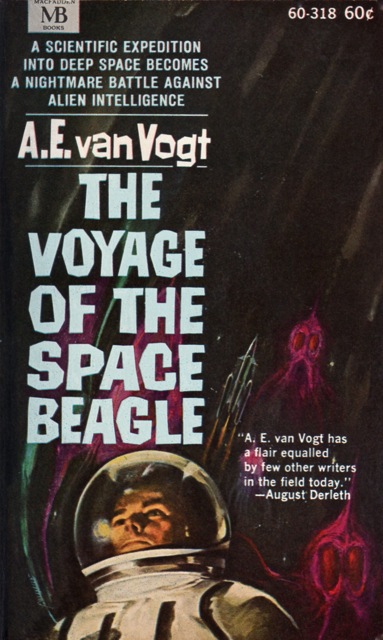
Voyage of the Space Beagle - A. E. van Vogt

The drive was on. The ship was accelerating, going ever deeper and faster through the gulf of blackness that separated the spiral galaxy, of which Earth was one tiny spinning atom, from another galaxy of almost equal size. That was the background to the decisive struggle that was now taking place. The largest, most ambitious exploratory expedition that had ever set out from the solar system was in the greatest danger of its existence. 


Continuing on with the 2nd novel in my old copy of Triad by A.E. Van Vogt, we get to what is probably regarded as his best "novel." I'm guessing that most people think of this one as his best novel simply because it's mentioned more frequently in articles and essays about him than his other novels, like The World of Null-A. I put "novel" in quotes because it's really built from four of his short stories published during the Golden Age of Science Fiction. And these were some of his best stories, as long as you're asking me. Most of A.E. van Vogts "novels" were built from previously published short stories. Building a novel this way can come with some hurdles. They're often awkward and poorly paced. I think I read somewhere that A.E. van Vogt intended a climactic bit of action approximately every 800 words in any given story. This leads to a breathless pace that is hard to maintain for an entire novel. I've also read that some of his stories were inspired by dreams, which is another hurdle to leap if you're going for continuity and logic. But that's all stuff for the critics to bicker over.

Voyage of the Space Beagle is probably the best novel to read if you're going to read anything by van Vogt. I say this with a caveat that his short stories, particularly the early ones like "Black Destroyer" are better in their original forms. Voyage of the Space Beagle begins with "Black Destroyer" which was first published in Astounding Science Fiction way back in July of 1939. I first read "Black Destroyer" in a collection called The Great SF Stories 1 1939 published by DAW books in 1979. That collection was edited by Isaac Asimov and Martin H. Greenberg, and was the first of what was planned to be a year by year gathering of the greatest Science Fiction stories, as chosen by the editors. I bought that paperback the year it was published and was absolutely enthralled by the stories in it. 1939 was deliberately chosen by the editors as being the launch of what is known as the Golden Age of Science Fiction. If you happen to see any of these DAW editions of The Great SF Stories I'd say grab them, because you're guaranteed some excellent reading. I still have the first 7 books in the series, and wish I had more. As far as I was concerned I needed no other Science Fiction anthologies with these coming down the line. Unfortunately I missed the last half of the 40s and later.

July 1939

"Black Destroyer" just might have influenced the creators of the movie Alien, directed by Ridley Scott. Same can be said for another story "Discord in Scarlet" that makes up part of the latter half of Space Beagle. If you have a chance to read "Black Destroyer" do it. It's an excellent example of A.E. van Vogt at his best. It's that whiz-bang action science fiction pulp adventure that nerds like me love. Basically, an expedition from Earth lands on what they believe is an extinct planet and finds a lone cat-like creature outside the ruins of an ancient city. They let the creature board their ship only to learn in horror that it intends to feed off them as it takes control of their ship.

December 1939

As for the Space Beagle itself, we're told that it's manned by approximately 1000 men, made up of both scientists and military personnel. Yup, I said men, because the Space Beagle is a sausage factory. There isn't a single female on board. Maybe a poster or two of Jean Harlow over a bunk, but definitely no women. In order to manage an expedition so long without women, the men have taken some kind of drug that inhibits their libidos. Apparently women would be just too much of a distraction and there'd probably all kinds of fights over them going on and stuff like that. Or, in the future, according to A.E. van Vogt, women just ain't cut out for interstellar explorations. I suppose I should mention that one might think Voyage of the Space Beagle influenced Star Trek. Perhaps, but who can say. Certainly their exploratory missions sound similar even if the Enterprise had women on board.

After the events of "Black Destroyer" are settled we get into some of the politics of the Space Beagle. Our hero of the novel is a Nexialist scientist named Grosvenor. He's the only Nexialist on board, so he's got to deal with a bunch of professional rivalries and power plays. But through each of the adventures, it's always Grosvenor who comes up with the best solution. Grosvenor and Nexialism is the glue that holds the episodic structure of the novel together. Nexialism is described as "joining in orderly fashion the knowledge of one field of learning with that of other fields." It works better here than other cobbled together novels by the author. The individual pulp stories fit together with more elegance with Grosvenor as a lead protagonist.

The two other stories making up Space Beagle's adventures are "War of Nerves" from 1950 and "M33 in Andromeda" from 1943.

MacFaddon Books March 1968

I had a good time reading the book. I'm not totally jazzed on the title. I remember a friend of mine years ago seeing my paperback copy of Space Beagle (seen here) and cracking up at the cheesiness of it. I can't really blame her. It's kind of a clunker of a title and the dude on the cover always reminds me of Major Matt Mason. You've got to be of a certain age to know who Major Matt Mason is.

That's about it for A.E. van Vogt for now. I still have Slan to read in my collection, but I'm about pulped out with his novels, so I'll spare you a triple play. I will get to it eventually though.

Friday, December 15, 2017

The World of Null-A - A.E. van Vogt

He waited till the blazing beacon of the Games Machine was like a raging fire below him, then slightly behind. He saw the vaguely shaped buildings of the presidential residence just ahead. When the plane was almost over the palace, he pulled the trigger of the exit door.

Instantly he was falling though the foggy darkness.


So, let me see if I can get this straight. I’m warning you now that you need to buckle in and hold on tight because this dang novel careens all over the place! And spoiliers ahead, so you may want to skip some of the stuff below.

Our hero, Gilbert Gosseyn, arrives at the city of The Machine, in the World of Null-A (the planet Earth), to participate in The Games. During the month-long duration of The Games, there is no police protection for citizens. All citizens can join in the Games, wherein their future roles in society are determined through an analysis of their performance level in The Games. Within his first day Gosseyn is accused of being an imposter by another contestant. Gosseyn’s memories of his dead wife, Patricia Hardie, are denied. It’s revealed that the real Patricia Hardie is alive and living in the presidential palace of The Machine with her father Micheal Hardie, the President of Earth. Gosseyn allows himself to be subjected to a Lie Detector (you’ll learn that there are no shortages of Lie Detectors in this novel) which reveals that his identity as Gosseyn is phony, but that his real identity is too embedded to reveal itself. Gosseyn is then evicted from the hotel where he’s staying. Wandering through the city he meets a young woman calling herself Teresa Clark, who tells him she’s unprotected and fleeing from her boss after refusing his advances. Gosseyn and Teresa spend the night in a park. The following day, they go together to The Machine to participate in The Games where it’s Gosseyn’s hope that his performance will earn him a position on the planet Venus. He sees Teresa sneaking away from the Games to enter the Palace. That night, they meet again in the park where he decides not to let on that he’s suspicious of her. It doesn’t matter because he’s suddenly arrested and taken by flying car to the Machine where he learns that Teresa is really Patricia Hardie, the President’s daughter! He’s taken into an interrogation room where he meets Jim Thorson and another strange, half-cyborg dude referred to only as X. An attempt is made by Thorson and X to penetrate Gosseyn’s memory blocks to discover his real identity. It fails and Gosseyn is confined to a cell, where he’s quickly sprung out of by a sneaky Patricia Hardie who hides him in her private chambers. There, she’s visited by someone named Eldred Crang. Teresa…er, I mean Patricia Harding, and Crang discuss some political intrigue while Gosseyn remains hidden, listening to them. A conspirator named Prescott is mentioned by Crang. Gosseyn’s eavesdropping is interrupted by guards barging into the chambers looking for him. He leaps over the balcony onto the palace grounds and attempts to flee but is blasted by flaming ray-guns and is killed. Next thing Gosseyn knows is he wakes up in a forest on the planet Venus!

Are you still with me here?

Gosseyn follows a light to a house which is conveniently occupied by Prescott and his wife. Yup, this is the Prescott who is in cahoots with Crang, back on Earth, or Null-A, or just…whatever. Gosseyn jumps Prescott and his wife, and tries to get the scoop from them on what the hell is going on. Prescott says that he needs to see a guy named Eldred Crang, who lives on the other side of the forest. Gosseyn leaves Prescott tide up and takes his wife with him as hostage, then lets her go, and finds Crang’s residence on his own. Crang is gone, so Gosseyn hangs around his place reading books and sleeping and eating. After a couple days Crang shows up with detectives and arrests Gosseyn. Crang wants to know how Gosseyn is alive on Venus after being killed on Earth. They all climb into a ship and travel back to Earth, to the Machine. At the Machine Gosseyn is returned to Thorson and X and is taken to a room where he’s allowed to see his own dead body. Also in the room is Prescott’s wife for some reason. Patricia Hardie and her father show up and everyone is agitated about a conspiracy and how Gosseyn plays into it, but things go no further than that because everyone collapses by an invisible gas emitted through the air conditioner by Prescott. But Gosseyn doesn’t succumb to the gas because he was given an antidote ahead of time by Prescott. Unfortunately, Prescott’s wife dies, so Prescott goes sort of berserk and blasts X, President Hardie and some guards, with his ray gun and is just about to kill Thorson when Gosseyn disarms him. They escape and leave the palace together in a getaway car. It’s determined that Gosseyn should see the brilliant psychiatrist Dr. Kair who may be able to get past all the blocked memories to discover who Gosseyn really is and how he fits into this whole plot. At Dr. Kair’s office, Gosseyn undergoes a battery of Lie Detectors (remember those?) that indicate he has a second brain that has untapped potential to alter the course of events. Gosseyn uses his Null-A training to figure out that Prescott never intended to kill Thorson, and just wanted to frame Gosseyn for the assassination of President Hardie. Knowing he can’t trust Prescott, Gosseyn and Dr. Kair tie him up and take off for Dr. Kair’s island retreat where Gosseyn can further train his 2nd brain. Halfway there Gosseyn decides he needs to return to The Machine instead, so he rigs Dr. Kair’s plane to reverse course while Kair is asleep and he steals a parachute and bails out midair. Before doing so, he leaves the sleeping Dr. Kair a note telling him to place an ad in the personals column should he need to contact him for any reason. Back at the Machine, Gosseyn hooks up with Patricia Hardie again and she informs him that Venus and Earth are under invasion by men from another star system and that he needs to work with Crang to somehow halt the invasion. It turns out that her father was a tool for X and Thorson, and that Thorson is leading the invasion. But in order to help Crang, Gosseyn has to commit suicide so that his third hidden body, Gosseyn III, can come to life and utilize the full potential of his 2nd brain. Gosseyn checks into a hotel and hypnotizes himself to commit suicide, but instead he receives telepathic messages from the Machine informing him that he must not kill himself because the Machine is under attack and Gosseyn’s hidden 3rd body has been destroyed.


Gosseyn and Crang return to Venus where Crang explains the whole invasion plan to Gosseyn and that Thorson is leading the charge to wipe out Venus and Earth. While on Venus they see the Venusians, who are really Null-A Earthlings, halt the invading forces using guerrilla warfare tactics. They return to Earth to discover the Machine and the Palace are in ruins, on the edge of total annihilation. Crang takes Gosseyn to see Patricia Hardie again where Gosseyn ties her up to find some kind of machine named The Distorter that blocks transmissions or something like that. Patricia Hardie tells Gosseyn that to halt the invasion once and for all he needs to go to a hidden chamber of the Machine and see a man with a beard. She doesn’t know the guy’s name; just that he’s old and has a beard. Gosseyn is captured by Prescott before he can get there and is used by Prescott to infiltrate the remaining strongholds of The Machine. Gosseyn pulls a trick play on Prescott, thanks to some handy telepathic communication from within The Machine. Gosseyn kills Prescott, gets inside The Machine and finds the man with the beard who turns out to be X whose real name is Lavoisseur. Lavoisseur founded the philosophy of Null-A back 500 years ago and has remained alive by living through several bodies after each body dies. Together, Gosseyn and Laviosseur beat the invasion by means of The Distorter, but Lavoisseur succumbs to injuries and dies before he’s able to tell Gosseyn who Gosseyn really is. Gosseyn mourns the death of Lavoisseur for a few minutes before thinking he recognizes Lavoisseur from somewhere. He gets a razor and shaves off Lavoisseur’s beard and recognizes his own face!

Gosh, the only thing this whole plot was missing was a dwarf in a top hat running around randomly kicking people in the ass! I guarantee you that I didn’t get some of that plot correct, and I just finished the book a day ago. It goes without saying that this book has a lot going on in it. Too much going on, actually. There is so much going on that you’re never really grounded in understanding anything. At least I wasn't. Maybe I'm getting old. I have no idea what Null-A means other than it’s Non-Aristotelian logic, I think.

But so what? That doesn’t mean anything to me. And I gave up keeping track of the double crosses and switcheroos performed by Prescott and Patricia Hardie and the rest of the gang. But whatever! The World of Null-A is considered something of a Golden-Age Classic and I’m not gonna be a jerk and shoot it down. Because, in the end, it was kind of fun reading the damn thing.  


It was first published in serial format in Astounding Science Fiction in 1945. At the time Astounding was edited by John W. Campbell who is credited by many as the main guy who oversaw what’s been called the Golden Age of Science Fiction. Campbell took science fiction away from pulpy, melodramatic space-opera type stories into more serious, science-based stories in Astounding. If you couldn’t meet his high standards, you didn’t get published by him. Certainly, there was plenty of space-opera still around. I have a few issues of Astounding from the 1930’s and completely dig them, but they were before Campbell’s time, mostly. Campbell brought writers like A.E. van Vogt, Robert Heinlein and Theodore Sturgeon into the field. He was a huge influence on Isaac Asimov’s early writing. He also got into Dianetics and published L. Ron Hubbard’s early articles on the subject. A.E. van Vogt also jumped onto the Dianetics field. Maybe someone with more expertise than me can say if Null-A is a response to Dianetics, since the novel was dedicated to Campbell.


My version of this novel was published in a hardback collection of 3 novels by A.E. van Vogt. The original owner of my book was kind enough to leave a note inside the cover informing me that he finished reading it on September 9th, 1963. My intent is to follow this post up with the remaining novels in the collection, Voyage of the Space Beagle and Slan. But who knows…I ain’t the most reliable kid on the block.


Friday, November 24, 2017

Holiday Stuffing

With the Thanksgiving holidays on us, and a few long weekends between my last post, I had a chance to get some reading done, in addition to the full-time day job I’m chained to.

For non-fiction, I finished The Long Gray Line by Rick Atkinson. This book details the lives of various graduates of the West Point class of 1966, from their first year at West Point, through their experiences in Vietnam and after. It’s a long book and painful in many parts. America was an ugly place then. Still is in many ways. I’m not sure we’ve learned any lessons from the past and often wonder if we’re cursed to run in place on a hamster-wheel of folly. 

So, on to the more fun stuff. In addition to the West Point book, I read a cool little sleaze paperback from Monarch Books, Tropic of Cleo by Rick Holmes. I spent a Saturday afternoon manning a market stall reading an old Avenger paperback, River of Ice by Paul Ernst, under the house name of Kenneth Robeson. And lastly, a pretty cool crime novel from the early fifties by Wade Miller called The Big Guy.


The Big Guy is a morality tale of sorts about the rise and fall of a small time hood, Joe Drum, into the top ranks of the Los Angeles underworld. If you’ve seen the movie Scarface (either version) you have a pretty good idea what’s in store for our anti-hero Drum. He’s a single minded beast, (even his name is symbolic for the loud storm from a hollow instrument) whose drive takes him to the top of the game. Unfortunately, when you’re at the top there is only one direction you can go. And man, does he go, thanks to the help of a woman named Patience. There are a lot of nightclub scenes, party scenes, gun-play and betrayal going on throughout, and you read along waiting for the fall of Joe Drum. There is a neat psycho-sexual warfare going on that plays a huge part of Joe’s demise. This is the 2nd novel by Wade Miller (in reality, two pals named Robert Wade and Bill Miller) that I've read after Kitten with a Whip. The style is on this side of over-written, at least in this novel, but once the story hits its stride it moved at a good clip. If you're interested in trying any Wade Miller novels, Stark House Press has reprinted a few of their novels, and used copies of their paperbacks are fairly easy to find. 


Tropic of Cleo is one of those “treasure hunt” capers that could have been written by Gil Brewer. Harry Gregory and his wife Cleo arrive in the Bahamas to meet “an old college friend” of Harry’s. Right off the bat we learn that Cleo has a raging case of the hot pants and you know that wherever she goes trouble will follow. Cleo comes across as bitchy, bored and alcoholic, and enjoys needling Harry at every opportunity. Harry’s pal, Gene Freeman, arrives, along with Max Heinrich and the three of them begin making their plans. Heinrich is a former WWII P.O.W. who holds the secret location to a treasure trove of stolen loot worth about 2 million dollars in his brandy-addled head. The problem is that he doesn’t know exactly which island the loot is buried on. Cleo thinks the whole thing is hooey and isn’t shy about letting the guys know her opinion. She’s also got Gene Freeman all in a lather for her. Freeman makes no bones about putting the moves on Cleo every chance he gets. Enter the picture a seaman for hire named Casey Stribling and Marla Keever. Casey and Marla had a thing going, until Casey got tired of Marla. Casey is one of those golden sun-god types that gets Cleo’s temperature up, and next thing you know, you have a boatload of bottled-up passions and lusts ready to explode. This is the kind of plot where the idea of stocking up supplies means having plenty of hooch on hand to guzzle. There are a couple hot-sex scenes going on and one wild catfight. This is not the kind of stuff that would not find a reputable publisher today. I enjoyed Tropic of Cleo for what it was, a politically incorrect, sexy (for its time) caper with plenty of booze and duplicity and assorted shenanigans going on. I’ve never read a thing by Rick Holmes before, but it was right there in the Gil Brewer style of writing to keep things from ever slowing down, forcing you to think too much about the preposterous situation the gang’s all in. 


Finally, a quick look at The Avenger: River of Ice. This was the 11th Avenger adventure, first appearing in July 1940. These pulp novels were reprinted in the 1970’s by Warner Paperbacks. I remember seeing them all the time in the Waldenbooks at the mall when I was a kid. They were right there alongside the Doc Savage novels that usually got my 75 cents at the time. I’ve read a lot of Doc Savage novels over the years, and only a few Avenger novels. I’m going to have to say it. The couple of Avenger novels I’ve read were better than many of the Doc Savage novels I can think of off the top of my head. That's probably fightin' words among pulp nerds! I understand that The Avenger was a response to the success of both Doc Savage and The Shadow. Paul Ernst was hired to write the early Avenger adventures after consulting with Walter Gibson and Lester Dent, authors of most of The Shadow and Doc Savage novels, respectively. The Avenger is an adventurer named Richard Benson who turns to fighting crime after his wife and daughter are murdered. The shock of their deaths turns Benson’s face and hair a ghostly white. His features are also paralyzed. This allows his face to become malleable, thereby providing ample opportunity for disguise. He’s kind of like Doc Savage, The Shadow and Batman, in that he has an arsenal of gadgets and chemicals at his disposal. He also, like Doc Savage, does not kill criminals; instead he allows them to kill themselves by their own actions. This adventure has a lost civilization theme to it, wherein a gruesome surgical method for creating obedient slaves by sticking a steel needle into the brains of people is used as a plot device. There are chases, fights and perils aplenty in this romp, including a not particularly difficult mystery about who the evil genius is causing all the turmoil. It’s nicely paced, keeping up a lot of suspense right up to the ending. I would imagine that Avenger paperbacks are relatively easy to find out there in the wild. I mostly see Doc Savage paperbacks but every so often an Avenger book shows up.

So that’s about all for now. Happy hunting. 

Monday, November 6, 2017

Never Die Alone - Donald Goines

It seems as if half of Los Angeles' finest detectives raided my old apartment. Now I'm not sure it's related to the trip that Billy made. I can't think of any other motherfuckin' reason for the police to come storming into where I had lived. From the information that I have been able to gather, the boys in blue were put out because I hadn't sat still and waited for them. If it hadn't been for me using a little foresight, I think I would have been behind bars at this moment, instead of writing these notes down. 

Holloway House Publishing Company, cover photography by Jeffrey
The only thing that Donald Goines was missing was an editor. His novels were written, according to sources I've read, to support a drug habit, and were churned out in first drafts and sold at a furious pace to keep his demons at bay. I've read a handful of his novels over the years and have liked every one of them, but finish them wishing that someone had tamed the force that produced them. But perhaps they wouldn't have that voice and grit that make them urban fiction classics. That voice! In the space of 4 years, from 1971 to 1975, he published 16 crime novels. In 1974 he was gunned down in his home. The person(s) responsible have never been determined.

Goines wrote of the life he lived as an addict and people he knew. Never Die Alone is sort of all over the place, but has a way of holding up by its own narrative drive. It begins with a young writer, Paul Pawlowski, preparing to go to a job interview for a "leftwing" newspaper. We're given a lot of detail in Paul's ancestry that is never part of the plot. In the second chapter we're introduced to King David, known on the streets as King Cobra, who is returning from 5 years in California. King David left New York owing money to a lot of bad characters, including a small-time gangster named Moon. Arrangements are made for King David to pay Moon back, with the understanding that Moon will not sic his henchmen on David. Moon agrees, figuring that he'll let an up and comer in the underworld named Mike take care of King David after collecting the money owed. Mike has personal reasons for getting even with King David, because David once robbed his mother of her government check and beat her and him with a Coke bottle in the process. King David was a pusher and con artist, who has left a trail of junkies and victims in his path.

Of course, as things always do in crime novels, things get fucked up really fast. King David survives the sloppy hit job on him, barely, leaving one hoodlum half dead with a knife wound to his eye and witnesses, including Paul Pawloski and Mike's sister, Edna who was used as a kind of honey-trap on David. Paul manages to get King David to a hospital before he succumbs to his wounds. David's last request to the doctors in the hospital is that Paul inherit his Cadillac and all his possessions in it, including a journal that he kept of his time in California. Meanwhile, Moon is frantic that the botched hit on King David is going to bring the heat down on him. He sends out more henchmen to eliminate Mike and Edna. Well...you guessed it. That hit goes down bad as well. Edna is murdered, but Mike manages to kill Moon's flunkies in the process. All of Moon's henchmen are terrible shots, and that while people get killed, it's never the right people. Now Mike, bleeding from his wounds, is coming back for Moon. Meanwhile, Paul is home in his apartment reading King David's journal of his time in Los Angeles living in hotels and pushing heroin while passing it off as cocaine. David has affairs with a couple of young women who find him more customers looking for kicks. In the process, he falls in love with a girl named Juanita, who spurns his offers. She'll take his coke, but she ain't about to shack up with no two-bit jive-ass pusher and con man. Bad, bad move on her part as we'll learn.

King David's journal serves as sort of a novel within a novel, as it's presented as it was written by King David. We learn really quickly that King David was a monster, double-crossing and betraying just about anyone unfortunate enough to cross his path. I wonder if Goines had intended this journal to be a novel on its own, but got hemmed in by the first person point of view, then built the characters of Paul and Moon and the New York scenes around it instead.

Of course, there is no telling. So, in the end we have a flawed, but in its own a way a brilliantly flawed, novel of pimps and pushers and...writers! Strange brew and not for the timid. This novel gets violent and nasty before things come to a resolution.

In the end, I give it a recommendation. If you find any of Goines' novels out there, check them out.

Saturday, October 28, 2017

The Turn of the Screw - Henry James

It produced in me, this figure in the clear twilight, I remember, two distinct gasps of emotion, which were sharply, the shock of my first and that of my second surprise. My second was a violent perception of the mistake of my first: the man who met my eyes was not the person I had precipitately supposed. There came to me thus a bewilderment of vision of which, after these years, there is no living view that I can hope to give. An unknown man in a lonely place is a permitted object of fear to a young woman privately bred; and the figure that faced me was - a few more seconds assured me - as little anyone else I knew as it was the image that had been in my mind.

The ghost of Peter Quint in a scene from The Innocents, based on The Turn of the Screw.

In other words, she saw a ghost!

I really don't know if anyone reads Henry James anymore. To be sure, he's an acquired taste. Even among students of English Lit in various campuses across the country, he's probably hopelessly ignored now in the 21st century. And, much as I've enjoyed his novels, his prose can be aggravating to wade through. Sentences strewn with multiple commas, and asides, for which the perceptive reader, providing an intense concentration, illuminates, as it were, the depths beyond the surface of the events related to the passage of plot, a deeper understanding of...well, you get my drift here. Henry James is tough to read!

That said, his short novel The Turn of the Screw really is one of the best ghost stories you'll have the pleasure of enjoying once you give into its style. In keeping with the season, I thought it would be fun (whaaa? reading Henry James is fun???) to revisit his most famous ghost story set in an isolated manor deep within the English countryside.

The plot is relatively a simple one. A young governess is hired by the uncle of two small children, Miles and Flora, to oversee their care and education at his isolated country estate. The conditions of the governess's employment is that she, under no circumstances, communicates with, or otherwise disturb him, regarding their care. She is to take full charge over their well-being completely, leaving him free to pursue his bachelor ways alone in London. The job seems to be a delightful one for our young governess, until the ghosts of the prior governess, Miss Jessel,  and Peter Quint, the late groundskeeper, appear. We learn that Peter Quint and Miss Jessel enjoyed a sexual relationship before their untimely deaths. A relationship contaminated with hints of cruelty and violence. Convinced that their spirits have returned to corrupt the innocent children under her care, our young governess steels herself to confront the evil spirits and save her young charges.

There is a lot of psychological meat for the reader, and scholars, to chew on here. Are the ghosts real? Are they figments of the governess's imagination? Has her infatuation with her distant employer influenced her perception of her young charges? Are the children truly innocent, or have they been corrupted already by the late Peter Quint and Miss Jessel?

James has a ball with this story. It's steeped in gothic trappings, and a sly reference to The Mysteries of Udolpho (a gothic classic that I'll probably get around to reading at some point) is made. It's been adapted for film several times, and even had a major influence on a Dark Shadows plot-line. I think it's worth reading for anyone who considers themselves a horror fan. A good old fashioned ghost story, no matter how literate, never goes out of style. And this one is one of the best.


Sunday, October 15, 2017

It Came from the Drive-In

Betty Jane screamed and struggled to no avail against the brutish SS guards. "You'll pay for this! I'm a cheerleader at Denton High!"  

In a moment Betty Jane was stripped down to her white cone-shaped bra and panty-girdle and beige stockings. Flicking her riding crop, Elsie walked about her, studying Betty Jane closely. She playfully tugged at Betty Jane's blond ponytail.   - "Plan 10 From Inner Space" by Karl Edward Wagner

DAW Books February 1996. Cover by Vincent Di Fate

Yikes! Poor Betty Jane! I hope her boyfriend can rescue her in time before those evil Nazi bastards have their way with her!

So being the right time of the year for completely over the top horror fun, It Came from the Drive-In, edited by Norman Partridge and Martin H. Greenberg (what anthology didn't this guy edit?) provides more than a fare share of the stuff your grandmother warned you about! This was one of those perfect anthologies that screamed at you from bookshelves of your favorite bookstore twenty-some years ago. Every story in this collection is a lurid homage to those awesome drive-in movies last seen sometime in the late seventies before video rental stores moved into the strip malls.

With titles like "Die, Baby, Die, Die, Die" and "The Blood on Satan's Harley" and "The Good, the Bad, and the Danged" you're guaranteed to find something you're not supposed to like in this collection. Partridge and Greenberg put together these all original stories in the true spirit of grindhouse glory.

Horror sometimes takes itself a bit too seriously, and my biggest gripe against it these past few years (decades!) is that it's lost its mojo. It's supposed to be like a carnival ride, like candy that rots your teeth. Horror is supposed to be that girl by the lockers who smokes Marlboros while mocking the kids on the football team. And the scruffier, naughtier and sexier, the better as far as I'm concerned. That's the stuff that pulls me in. I know a ton of people will probably disagree with me and that's cool, but I've always looked for the strings dangling that rubber vampire bat and skeleton instead of something that's just there to depress me or gross me out. These stories by Ed Gorman, Nancy A. Collins, Norman Partridge, etc. take that spirit of horror/science fiction and make it fun. It was this kind of spirit that...(shameless plug coming up!) I wrote my first published novel, SIRENS, with. Whether I succeeded or not is up to readers, what few I get, to decide.

I'm glad to see that this terrific anthology hasn't disappeared, as it looks like copies are still available out there. Short stories this fun are getting rare and it's my hope that their spirit keeps rattling those rusty chains in your attic for a long time to come.