Showing posts with label A. E. van Vogt. Show all posts

Sunday, December 17, 2017

Voyage of the Space Beagle - A. E. van Vogt

The drive was on. The ship was accelerating, going ever deeper and faster through the gulf of blackness that separated the spiral galaxy, of which Earth was one tiny spinning atom, from another galaxy of almost equal size. That was the background to the decisive struggle that was now taking place. The largest, most ambitious exploratory expedition that had ever set out from the solar system was in the greatest danger of its existence. 


Continuing on with the 2nd novel in my old copy of Triad by A.E. Van Vogt, we get to what is probably regarded as his best "novel." I'm guessing that most people think of this one as his best novel simply because it's mentioned more frequently in articles and essays about him than his other novels, like The World of Null-A. I put "novel" in quotes because it's really built from four of his short stories published during the Golden Age of Science Fiction. And these were some of his best stories, as long as you're asking me. Most of A.E. van Vogts "novels" were built from previously published short stories. Building a novel this way can come with some hurdles. They're often awkward and poorly paced. I think I read somewhere that A.E. van Vogt intended a climactic bit of action approximately every 800 words in any given story. This leads to a breathless pace that is hard to maintain for an entire novel. I've also read that some of his stories were inspired by dreams, which is another hurdle to leap if you're going for continuity and logic. But that's all stuff for the critics to bicker over.

Voyage of the Space Beagle is probably the best novel to read if you're going to read anything by van Vogt. I say this with a caveat that his short stories, particularly the early ones like "Black Destroyer" are better in their original forms. Voyage of the Space Beagle begins with "Black Destroyer" which was first published in Astounding Science Fiction way back in July of 1939. I first read "Black Destroyer" in a collection called The Great SF Stories 1 1939 published by DAW books in 1979. That collection was edited by Isaac Asimov and Martin H. Greenberg, and was the first of what was planned to be a year by year gathering of the greatest Science Fiction stories, as chosen by the editors. I bought that paperback the year it was published and was absolutely enthralled by the stories in it. 1939 was deliberately chosen by the editors as being the launch of what is known as the Golden Age of Science Fiction. If you happen to see any of these DAW editions of The Great SF Stories I'd say grab them, because you're guaranteed some excellent reading. I still have the first 7 books in the series, and wish I had more. As far as I was concerned I needed no other Science Fiction anthologies with these coming down the line. Unfortunately I missed the last half of the 40s and later.

July 1939

"Black Destroyer" just might have influenced the creators of the movie Alien, directed by Ridley Scott. Same can be said for another story "Discord in Scarlet" that makes up part of the latter half of Space Beagle. If you have a chance to read "Black Destroyer" do it. It's an excellent example of A.E. van Vogt at his best. It's that whiz-bang action science fiction pulp adventure that nerds like me love. Basically, an expedition from Earth lands on what they believe is an extinct planet and finds a lone cat-like creature outside the ruins of an ancient city. They let the creature board their ship only to learn in horror that it intends to feed off them as it takes control of their ship.

December 1939

As for the Space Beagle itself, we're told that it's manned by approximately 1000 men, made up of both scientists and military personnel. Yup, I said men, because the Space Beagle is a sausage factory. There isn't a single female on board. Maybe a poster or two of Jean Harlow over a bunk, but definitely no women. In order to manage an expedition so long without women, the men have taken some kind of drug that inhibits their libidos. Apparently women would be just too much of a distraction and there'd probably all kinds of fights over them going on and stuff like that. Or, in the future, according to A.E. van Vogt, women just ain't cut out for interstellar explorations. I suppose I should mention that one might think Voyage of the Space Beagle influenced Star Trek. Perhaps, but who can say. Certainly their exploratory missions sound similar even if the Enterprise had women on board.

After the events of "Black Destroyer" are settled we get into some of the politics of the Space Beagle. Our hero of the novel is a Nexialist scientist named Grosvenor. He's the only Nexialist on board, so he's got to deal with a bunch of professional rivalries and power plays. But through each of the adventures, it's always Grosvenor who comes up with the best solution. Grosvenor and Nexialism is the glue that holds the episodic structure of the novel together. Nexialism is described as "joining in orderly fashion the knowledge of one field of learning with that of other fields." It works better here than other cobbled together novels by the author. The individual pulp stories fit together with more elegance with Grosvenor as a lead protagonist.

The two other stories making up Space Beagle's adventures are "War of Nerves" from 1950 and "M33 in Andromeda" from 1943.
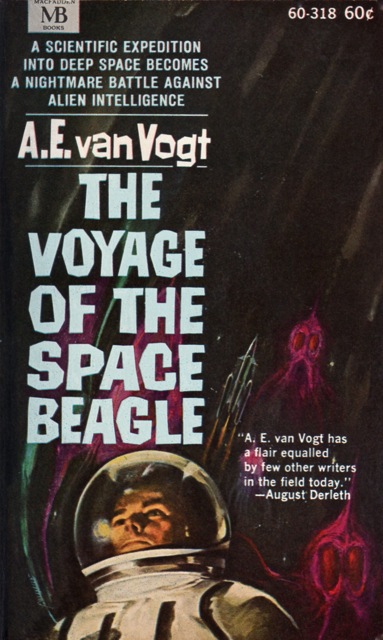
MacFaddon Books March 1968

I had a good time reading the book. I'm not totally jazzed on the title. I remember a friend of mine years ago seeing my paperback copy of Space Beagle (seen here) and cracking up at the cheesiness of it. I can't really blame her. It's kind of a clunker of a title and the dude on the cover always reminds me of Major Matt Mason. You've got to be of a certain age to know who Major Matt Mason is.

That's about it for A.E. van Vogt for now. I still have Slan to read in my collection, but I'm about pulped out with his novels, so I'll spare you a triple play. I will get to it eventually though.

Friday, December 15, 2017

The World of Null-A - A.E. van Vogt

He waited till the blazing beacon of the Games Machine was like a raging fire below him, then slightly behind. He saw the vaguely shaped buildings of the presidential residence just ahead. When the plane was almost over the palace, he pulled the trigger of the exit door.

Instantly he was falling though the foggy darkness.


So, let me see if I can get this straight. I’m warning you now that you need to buckle in and hold on tight because this dang novel careens all over the place! And spoiliers ahead, so you may want to skip some of the stuff below.

Our hero, Gilbert Gosseyn, arrives at the city of The Machine, in the World of Null-A (the planet Earth), to participate in The Games. During the month-long duration of The Games, there is no police protection for citizens. All citizens can join in the Games, wherein their future roles in society are determined through an analysis of their performance level in The Games. Within his first day Gosseyn is accused of being an imposter by another contestant. Gosseyn’s memories of his dead wife, Patricia Hardie, are denied. It’s revealed that the real Patricia Hardie is alive and living in the presidential palace of The Machine with her father Micheal Hardie, the President of Earth. Gosseyn allows himself to be subjected to a Lie Detector (you’ll learn that there are no shortages of Lie Detectors in this novel) which reveals that his identity as Gosseyn is phony, but that his real identity is too embedded to reveal itself. Gosseyn is then evicted from the hotel where he’s staying. Wandering through the city he meets a young woman calling herself Teresa Clark, who tells him she’s unprotected and fleeing from her boss after refusing his advances. Gosseyn and Teresa spend the night in a park. The following day, they go together to The Machine to participate in The Games where it’s Gosseyn’s hope that his performance will earn him a position on the planet Venus. He sees Teresa sneaking away from the Games to enter the Palace. That night, they meet again in the park where he decides not to let on that he’s suspicious of her. It doesn’t matter because he’s suddenly arrested and taken by flying car to the Machine where he learns that Teresa is really Patricia Hardie, the President’s daughter! He’s taken into an interrogation room where he meets Jim Thorson and another strange, half-cyborg dude referred to only as X. An attempt is made by Thorson and X to penetrate Gosseyn’s memory blocks to discover his real identity. It fails and Gosseyn is confined to a cell, where he’s quickly sprung out of by a sneaky Patricia Hardie who hides him in her private chambers. There, she’s visited by someone named Eldred Crang. Teresa…er, I mean Patricia Harding, and Crang discuss some political intrigue while Gosseyn remains hidden, listening to them. A conspirator named Prescott is mentioned by Crang. Gosseyn’s eavesdropping is interrupted by guards barging into the chambers looking for him. He leaps over the balcony onto the palace grounds and attempts to flee but is blasted by flaming ray-guns and is killed. Next thing Gosseyn knows is he wakes up in a forest on the planet Venus!

Are you still with me here?

Gosseyn follows a light to a house which is conveniently occupied by Prescott and his wife. Yup, this is the Prescott who is in cahoots with Crang, back on Earth, or Null-A, or just…whatever. Gosseyn jumps Prescott and his wife, and tries to get the scoop from them on what the hell is going on. Prescott says that he needs to see a guy named Eldred Crang, who lives on the other side of the forest. Gosseyn leaves Prescott tide up and takes his wife with him as hostage, then lets her go, and finds Crang’s residence on his own. Crang is gone, so Gosseyn hangs around his place reading books and sleeping and eating. After a couple days Crang shows up with detectives and arrests Gosseyn. Crang wants to know how Gosseyn is alive on Venus after being killed on Earth. They all climb into a ship and travel back to Earth, to the Machine. At the Machine Gosseyn is returned to Thorson and X and is taken to a room where he’s allowed to see his own dead body. Also in the room is Prescott’s wife for some reason. Patricia Hardie and her father show up and everyone is agitated about a conspiracy and how Gosseyn plays into it, but things go no further than that because everyone collapses by an invisible gas emitted through the air conditioner by Prescott. But Gosseyn doesn’t succumb to the gas because he was given an antidote ahead of time by Prescott. Unfortunately, Prescott’s wife dies, so Prescott goes sort of berserk and blasts X, President Hardie and some guards, with his ray gun and is just about to kill Thorson when Gosseyn disarms him. They escape and leave the palace together in a getaway car. It’s determined that Gosseyn should see the brilliant psychiatrist Dr. Kair who may be able to get past all the blocked memories to discover who Gosseyn really is and how he fits into this whole plot. At Dr. Kair’s office, Gosseyn undergoes a battery of Lie Detectors (remember those?) that indicate he has a second brain that has untapped potential to alter the course of events. Gosseyn uses his Null-A training to figure out that Prescott never intended to kill Thorson, and just wanted to frame Gosseyn for the assassination of President Hardie. Knowing he can’t trust Prescott, Gosseyn and Dr. Kair tie him up and take off for Dr. Kair’s island retreat where Gosseyn can further train his 2nd brain. Halfway there Gosseyn decides he needs to return to The Machine instead, so he rigs Dr. Kair’s plane to reverse course while Kair is asleep and he steals a parachute and bails out midair. Before doing so, he leaves the sleeping Dr. Kair a note telling him to place an ad in the personals column should he need to contact him for any reason. Back at the Machine, Gosseyn hooks up with Patricia Hardie again and she informs him that Venus and Earth are under invasion by men from another star system and that he needs to work with Crang to somehow halt the invasion. It turns out that her father was a tool for X and Thorson, and that Thorson is leading the invasion. But in order to help Crang, Gosseyn has to commit suicide so that his third hidden body, Gosseyn III, can come to life and utilize the full potential of his 2nd brain. Gosseyn checks into a hotel and hypnotizes himself to commit suicide, but instead he receives telepathic messages from the Machine informing him that he must not kill himself because the Machine is under attack and Gosseyn’s hidden 3rd body has been destroyed.


Gosseyn and Crang return to Venus where Crang explains the whole invasion plan to Gosseyn and that Thorson is leading the charge to wipe out Venus and Earth. While on Venus they see the Venusians, who are really Null-A Earthlings, halt the invading forces using guerrilla warfare tactics. They return to Earth to discover the Machine and the Palace are in ruins, on the edge of total annihilation. Crang takes Gosseyn to see Patricia Hardie again where Gosseyn ties her up to find some kind of machine named The Distorter that blocks transmissions or something like that. Patricia Hardie tells Gosseyn that to halt the invasion once and for all he needs to go to a hidden chamber of the Machine and see a man with a beard. She doesn’t know the guy’s name; just that he’s old and has a beard. Gosseyn is captured by Prescott before he can get there and is used by Prescott to infiltrate the remaining strongholds of The Machine. Gosseyn pulls a trick play on Prescott, thanks to some handy telepathic communication from within The Machine. Gosseyn kills Prescott, gets inside The Machine and finds the man with the beard who turns out to be X whose real name is Lavoisseur. Lavoisseur founded the philosophy of Null-A back 500 years ago and has remained alive by living through several bodies after each body dies. Together, Gosseyn and Laviosseur beat the invasion by means of The Distorter, but Lavoisseur succumbs to injuries and dies before he’s able to tell Gosseyn who Gosseyn really is. Gosseyn mourns the death of Lavoisseur for a few minutes before thinking he recognizes Lavoisseur from somewhere. He gets a razor and shaves off Lavoisseur’s beard and recognizes his own face!

Gosh, the only thing this whole plot was missing was a dwarf in a top hat running around randomly kicking people in the ass! I guarantee you that I didn’t get some of that plot correct, and I just finished the book a day ago. It goes without saying that this book has a lot going on in it. Too much going on, actually. There is so much going on that you’re never really grounded in understanding anything. At least I wasn't. Maybe I'm getting old. I have no idea what Null-A means other than it’s Non-Aristotelian logic, I think.

But so what? That doesn’t mean anything to me. And I gave up keeping track of the double crosses and switcheroos performed by Prescott and Patricia Hardie and the rest of the gang. But whatever! The World of Null-A is considered something of a Golden-Age Classic and I’m not gonna be a jerk and shoot it down. Because, in the end, it was kind of fun reading the damn thing.  


It was first published in serial format in Astounding Science Fiction in 1945. At the time Astounding was edited by John W. Campbell who is credited by many as the main guy who oversaw what’s been called the Golden Age of Science Fiction. Campbell took science fiction away from pulpy, melodramatic space-opera type stories into more serious, science-based stories in Astounding. If you couldn’t meet his high standards, you didn’t get published by him. Certainly, there was plenty of space-opera still around. I have a few issues of Astounding from the 1930’s and completely dig them, but they were before Campbell’s time, mostly. Campbell brought writers like A.E. van Vogt, Robert Heinlein and Theodore Sturgeon into the field. He was a huge influence on Isaac Asimov’s early writing. He also got into Dianetics and published L. Ron Hubbard’s early articles on the subject. A.E. van Vogt also jumped onto the Dianetics field. Maybe someone with more expertise than me can say if Null-A is a response to Dianetics, since the novel was dedicated to Campbell.


My version of this novel was published in a hardback collection of 3 novels by A.E. van Vogt. The original owner of my book was kind enough to leave a note inside the cover informing me that he finished reading it on September 9th, 1963. My intent is to follow this post up with the remaining novels in the collection, Voyage of the Space Beagle and Slan. But who knows…I ain’t the most reliable kid on the block.


Saturday, January 14, 2017

The Weapon Makers - A.E. van Vogt

But each time she caught the desperate defeatism with a tight-lipped resistance. The House of Isher could not afford to destroy such a secret. Some day, it might play a vital part in preserving the Imperial House from resurgent enemies. She smiled at the intensity of her indecision. And there was no doubt in her mind that so long as the ship remained in existence the hours would seem long, and the Crown would be in mortal danger.


Tempo Books, cover art Paul Lehr
So yeah, I have both this book and its companion "novel" The Weapon Shops of Isher, which is supposed to come before this one but was built from stories published after the original serial publication of "The Weapon Makers" from February to April, 1943 in Astounding Science Fiction. If you think that's confusing, just wait.

I was supposed to read The Weapon Shops of Isher first, then this one. That's because it was published in novel form in 1952, a year after the other novel. It was again republished as One Against Eternity as part of an Ace Double. But really, I don't think it matters which one should be read first because, like most of the A.E. van Vogt stories and novels I've read, The Weapon Makers doesn't make a whole hell of a lot of sense by the time you're done.

Not to say that's a bad thing. This novel is such a Snap-Crackle-Whiz-Bang-Pulp of a Science Fiction adventure that plot and logic goes out the window in all the shit that's going on.

This one is about Captain Robert Hedrock and the struggle between the House of Isher and the Weapon Shops. The current Empress is the beautiful Innelda Isher who, at the start of the novel has just ordered the capture and death sentence of Hedrock for being a spy. Hedrock gets advance notice of this order and manages to escape Innelda Isher's soldiers from a banquet hall,  seeking sanctuary at the The Weapon Shops headquarters. Much to Hedrock's consternation, the Weapon Makers have issued their own death sentence on Hedrock, because they believe he is a spy for the House of Isher. You see, there's been a several thousand year long uneasy balance between the House of Isher and the Weapon Shops, which were designed to build and store weapons that could only be used in self defense against a tyrannical government. These Weapon Shops came about after the destruction of around a billion people in a war that just about destroyed the Earth and around the same time House of Isher rose to power from the nuclear ashes.

So anyway, Hedrock manages to flee the Weapon Makers  and escape into an underground laboratory where he's promptly attacked by a giant rat! The giant rat is the by-product of experiments that Hedrock has been conducting for the past several hundred years in an attempt to understand and harness the radioactive chain of events that made him immortal thousands of years ago. That's right, Hedrock is immortal...just go with it. Anyway, Hedrock is now on the hunt for a cat named Derd Kershaw, who has apparently come up with a design for an interstellar rocket ship that both the Weapon Shops and the House of Isher are determined to get their hands on. Apparently having this method of space travel at one's control insures superiority over one's enemies. Don't ask me why.

Hedrock's seach for Derk Kershaw leads him to twin brothers Gil and Dan Neeland. It turns out that Gil is looking for his brother Dan, who was involved in the rocket design that Derd Kershaw was overseeing. Through a confusing series of events Hedrock gets a job as a rocket designer for a suspicious dude named Greer, but when Hedrock reports to Greer he discovers that the building they're working in is really a hangar hiding the Kershaw's rocket ship! I'm throwing the exclamation point in because that's how things move in this novel.

Ed Valigursky cover art from 1970

So Hedrock dupes Greer long enough to tie him up, providing the opportunity to investigate the ability of the ship they're in. But, Greer has been in communication with security commanders from the House of Isher and they've now surrounded the hidden rocket ship with 800 cannons, or something, forcing Hedrock to assume Neeland's identity, after which he manages equip part of the ship with an interstellar drive and make his escape by blasting off into space, where he travels at many times the speed of light, ending up on a planet where he's captured by a species of giant spider-like aliens so advanced that they're capable of fusing identities through telepathy, allowing Hedrock to return to Earth under Neeland's identity!

(Whew! ...catching my breath here)

Back on Earth, Hedrock makes a giant man which then attacks the cities of the Empire, forcing the House of Isher and the Weapon Shops to form an alliance against the destruction of their cities.

At least I think that's what happens.

I'm telling you this novel shifts gears so many times that I was never really sure what was going on by halfway through it. The whole story moves like a dream, where shit just happens without any seeming design or logic. Somewhere in his career, A.E. van Vogt determined that in order to hold a reader's attention he'd have to keep the action fast and furious, and logic be damned. Much of this was a result of his novels being structured, or cobbled together, by previously published short stories from the pulps. At least this is true of his novels from the 50s. It was also during the 50s that A.E. van Vogt was involved in L.Ron Hubbard's Dianetics centers in California. So make of that what you will.

Most of A.E. van Vogt's novels are easily found in used bookstores for really cheap. It seems they were never out of print, finding new readers every generation. It's understandable because, in spite of their flaws, they're pretty fun to read. They're the stuff that inspired many more "sophisticated" novels that came after in Science Fiction. So take 'em for what they are.


Saturday, November 2, 2013

Away and Beyond - A.E. van Vogt

A.E. van Vogt is at his best in small doses. I've given some of his "novels" a go and typically bail on them before the halfway point. The problem, as has been well documented by way more scholarly types than myself, is that the novels are patch-worked up from previously published stories, often resulting in a confusing mess. Yes, moments of pulp glory will occasionally "pop!" (with exclamation points added just in case you're dozing off) but not to the benefit of a particularly enjoyable reading experience.

Jove/HBJ Edition - November 1977
His short stories are where he shines, glitters, pops and zooms at his best. You can usually get through them fast enough without thinking about them too hard. Which is a good thing. They don't stand up to critical scrutiny at all. There is all sorts of cool shit happening, but not a hell of a lot of it ever makes any sense.

I picked up this collection, along with a couple other vintage science fiction collections, for the measly price of a buck at a store closing down business. I'd read a few of van Vogt's stories in other collections, and outside of "Black Destroyer" and "Vault of the Beast" don't remember any of them. This collection opens with "Vault of the Beast" which I hadn't read in more than 30 years. I have to admit that the beginning of the tale really hooks you, where we meet a stowaway alien aboard a space freighter returning to earth. If you've seen The Terminator 2 you've got a pretty good idea of what the alien is capable of. And here in 1940 he's just as murderous in his mission to find a mathematician from Earth who can solve a riddle of the ultimate prime number, which will release a godlike alien trapped in a massive vault on Mars. Got it?

"The Great Engine" is about a war veteran who finds a piece of what may be part of an engine that propels a starship. There is government conspiracies in this one that get a little flaky, and something of a love story as well. "The Great Judge" is one of those tales that take place in a future Utopia where freedom of thought is frowned upon. "Secret Unattainable" is probably the best story in the book, told through a series of letters and correspondence about a scientist building the ultimate weapon for the Nazis in WWII. A.E. van Vogt has a tendency to shift POVs and scenes unexpectedly with jarring effects. Here in "Secret Unattainable" that habit is nullified by the epistolary method used. "The Harmonizer" is an alien plant, I think, but I wouldn't swear on it because I bailed out early. Maybe I'll go back and finish it. Same with "Heir Unapparent" where a galactic emperor has been poisoned by someone in his court. I didn't really care, so I didn't hang with the story. "The Second Solution" is reminiscent of "Black Destroyer" with a telepathic alien "monster" and her offspring stowing away on an Earthbound spaceship. There is reference made to a war with the Rulls, a wormlike like race of invaders wherein the ezwals, telepathic monsters like the ones on the spaceship, could possibly serve as allies and...oh, don't think about it too much...just dig the chase and bloodshed instead. "Film Library" is a "Twilight Zone" kind of story where short movies in 1946 somehow get switched for movies made in 2011. It's kind of fun, and ends with a scientific sounding gobbledy-gook explanation of how time is relative to a moment here and simultaneously somewhen else and...yeah, it's really not important. "Asylum" is pure pulp fever-dream with space vampires and horny babes, and bloodsucking and alien chases, and suppressed identity hoohaw that is pulled out of the air. It's long, but short enough to not fall apart.

That's the deal with this collection. A.E. van Vogt's books and stories are really easy to find in used bookshops. He remained in print well into the 70's. Maybe there was a lot of nostalgia for the pulp adventure and wonders of his his stories. Sophisticated readers today can appreciate their place in the genre's history. Other readers will be bored and unimpressed. You just got to be in the mood for them, and you'll have fun. Like candy, best in small doses.

Saturday, May 18, 2013

Empire of the Atom - A. E. van Vogt


I absolutely love old-school pulp Sci-Fi. Sometimes cynical, sometimes optimistic, frequently trite and juvenile; it almost always had a sense of wonder that was contagious. For me, that mostly went missing somewhere back in the sci-fi books of the 70s and later. Probably around the time the sci-fi section in Walden's got invaded by elves, dragons and wizards. I’m sure there are lots of great science fiction novels from the 70s that I’m completely unaware of, just like a lot of things under many subjects. But I do remember that the pickings in Walden’s and B. Daltons were pretty lame at the time. Lots of elves and swords, like I said, and I pretty much hated that stuff outside of Tolkien, and even then I wasn’t completely jazzed over it. So, it was mostly from the library that my adolescent taste in Science Fiction commenced.
My first introduction to A. E. van Vogt was in the old paperback collection by Asimov and Greenberg called The Great SF Stories 1 (1939) which contained "Black Destroyer" from July 1939 Astounding. It’s been years since I read “Black Destroyer” but it’s a terrific story that is no doubt the inspiration for movies like It! The Terror from Beyond Space and Alien. I know that it was re-written for the first part of the novel Voyage of the Space Beagle. I've got a tattered paperback of that novel hiding in my bookshelves somewhere, with its cover of an astronaut that looks strikingly like Major Matt Mason, if any of you remember him. I've yet to read Space Beagle, though I've started it a number of times. One of these days, right?
Cover by Malcolm Smith, Shasta Publishers 1957 

Anyway, back to A.E. van Vogt. I once read in an essay by Isaac Asimov that van Vogt "lost" many productive writing years to promoting Dianetics in California. Perhaps Asimov was referring to this period in which Empire of the Atom was produced. Pieced together from a series of stories published in the late 40s and early 50s this novel comes across as somewhat clumsy and stiff. Narrative summary often substitutes for the vim and vigor that A. E. van Vogt built his rep on. 

Empire of the Atom is the loose biography of the mutant Clane, and his rise within the Linn Dynasty somewhere around 14,000 AD. This is long after an atomic war decimated the earth's population. You’d think this seems like the right ingredients for a pretty high adventure sort of read. Instead this novel is surprisingly removed and dull. It was, all-in-all, sort of a let-down. 

Still, it wasn't a total waste of time. Here and there were still a few sparks of the old pulp magic that fans like me live for in these old stories. There is, for example, a pretty cool scene when Clane descends into an ancient atomic pit on the surface of Venus. Why exactly he was in Venus, well…I’m not sure. My memory is lost, dazed or confused about some of the plot points and I’m not sure that’s entirely my fault alone. Also there is another cool scene when frozen cadavers of an alien warrior race are discovered on the moons of Jupiter, but not a heck of a lot is made of them afterward. Still the novel had its moments that still make an old fan like me smile and turn the page to see what happens next.

There is a sequel to Empire called The Wizard of Linn. I picked it up the same time I got this book, knowing they were a set. I’m just not in much of a hurry to read it. Maybe it’s that word “wizard” in the title that’s preventing me…