Showing posts with label paperbacks. Show all posts

Saturday, January 26, 2019

W.H.O.R.E. - Carter Brown

The front door opened almost immediately, and what sounded like a million decibels of amplified Rolling Stones hit me right between the ears. It was obviously the kind of party where you were nothing but a lousy dropout if you didn't burst a blood vessel within the first five minutes. Standing right in front of me was a cowgirl, straight out of the Wild, Wild West. A silver-streaked blonde with her hair gathered into a topknot that gyrated madly every time she moved her head. She was wearing a blue jacket and matching mini-skirt and white knee-high cowboy boots. The jacket was unbuttoned all the way down the front, revealing the ultimate in cleavage. An open-range-sized martini was clutched precariously in her right hand.

Signet - October 1971
This is one of the Al Wheeler capers from Carter Brown, and plenty of early 70's shenanigans going on in it. Cowgirls, Rolling Stones, martinis in one chapter, dead babes and gun-toting goons dressed as Mickey Mouse and Donald Duck in another chapter. Also throw in a fruit-pickers demonstration into the mix and you have a "what the hell's going on?" kind of plot, where our hero Al Wheeler runs around the place trying to find missing suspects and dead bodies at the same time. And every clue leads him back to house that serves as the headquarters for a women's liberation group named W.H.O.R.E. which stands for Women's Hereditary and Obligatory Revolutionary Establishment, just so you pigs don't get the wrong idea!

It all kicks off when Wheeler responds to a beach house where the dead body of a beautiful young woman is discovered by a hysterical chick named Stephanie Channing. Stephanie claims to have no idea who the dead girl is. Stephanie was supposed to meet the owner of the cabin, a dude named Chuck Henry, who was to give her the keys to the place for the weekend. Stephanie immediately informs Wheeler that she's a foundation member of W.H.O.R.E., which provides Wheeler the opportunity to observe that she doesn't look like a lesbian! So yeah, it's that kind of a book. And Wheeler gets his fair share of crap from every member of W.H.O.R.E. he runs into throughout the novel. All of them are drop-dead hot, and all of them waste no time in calling Wheeler a pig. And all Wheeler can do is make cracks about none of them wearing a bra.

Well, as Stephanie is explaining how she came to find the body of the dead girl in the beach cabin, all of a sudden two gun-wielding goons show up wearing paper mache Mickey Mouse and Donald Duck masks. They put the drop on Wheeler and Stephanie and abscond with the body of the dead girl and a very much alive Stephanie after slugging Wheeling. From there on Wheeler has his hands full trying to convince his superiors at the Sheriff's office that a dead girl was whisked away by Mickey Mouse along with his only witness, a women's libber member of W.H.O.R.E. Just another routine case.

It's a goofy caper, and full of politically incorrect jabs at women throughout. I guess there is some turnabout in that Wheeler gets teased and tormented and made a fool of by just about every member of W.H.O.R.E. he comes across. Mind you, this is usually after they disrobe for him in the process. In the end, all of the loose ends get wrapped up, of course, and Wheeler gets the last quip.

These books are routinely entertaining and mindless romps with plenty of titillation and PG humor. This one is a standard Carter Brown novel in that regard, and I'll have forgotten the plot in a week. But a great cover anyway!


Sunday, November 4, 2018

Death for Sale - Henry Kane

He took one of Carter's cigarettes, lit it, blew smoke at the match to extinguish it. "Understand this, Mr. Winston. I'm not a pug-ugly, not a hoodlum, not a gangster. I perform independently and have no interest or curiosity in the motives of those who retain me. I command high fees because I am an expert and because there is a great element of risk. I take such risk into consideration as do others in hazardous professions--the people-jack, the high voltage worker, the test pilot. And if ever I'm caught, I shall accept even that philosophically--that is my way of life, and what comes must come. And now, if you please, what do you want of me, Mr. Winston?"

Dell - July 1957

And here you meet the wordiest hitman in the game. No, he doesn't talk his victims to death, not quite, but the reader may be an innocent bystander in the exchange. Death for Sale, by Henry Kane, was published in 1957. I don't believe I've read any other Henry Kane novels before this one. He's published a lot of books with cool covers on them, but I never see them out there in the the used bookshelves. I picked this one up 20 years ago in a flea market for 50 cents (the sticker is still in the book) and hadn't got around to reading it until this week.

It's got all the trappings of a classic noir plot: a husband is saddled with a shrew for a wife who refuses to divorce him, so in a moment of drunken anger hires someone to kill her. After sleeping on it, he wakes up with second thoughts and spends the rest of the novel trying to prevent the hit from going down. In this case, our reluctant husband is Carter Winston, a successful, 52 year old owner of a talent agency. His wife, Paula Sommers Winston, is twenty years younger, beautiful and rotten, and turns the bitch meter to 11 on the 1-to-10 scale. She makes no secret that she's seeing another man (she refuses to divulge who) while refusing to divorce Carter. She likes the setup, likes living in a mansion with servants, and likes the big life insurance policy on Carter's life. Carter Winston has a 19 year old daughter, Diane, from his first marriage. Diane's mother died when she was 13 or so. Carter Winston's marriage to Paula Sommers his only two years old, and we're given a summary of their whirlwind courtship in a few paragraphs early on in the book. In a moment of drunken frustration, Carter decides he has to have her killed, and hires a shady cat named Stewart Blake to do the job.

Why would a supposedly smart business guy marry someone so much younger? Well, we have an obvious theory here. Paula Sommers is a total smoldering hot babe. And Carter Winston is a stuffed shirt jerk-off. That's the biggest problem with this novel. It's preposterous. All noir plots are preposterous but you forgive them for it if the characters are relatable to the reader. You have to have a little empathy for at least one of them, or hate someone enough to want to see them get their just desserts. But with Death for Sale, you have characters so obnoxious that you really could care less what happens to them. Thankfully, the writing is crisp and professional, and the plot doesn't slow down long enough for you to not finish it. In spite of a few nice touches here and there, some moments of tension, the plot is more "drawing room mystery" than a true noir novel. For example, about a third way into the novel we're introduced to Cynthia Sommers, Paula's sister, who looks exactly like Paula! Then there is Carter's business partner Walter Moore, who's got a torch for Cynthia. Added to the mix is a kooky wannabe actress named Lola Cavanaugh who ends up being at the wrong place at the wrong time when our hitman, Stewart Blake, comes to complete his job.

By the end of the novel we have a gunshot in a storm, a chase through the night, and an overly complex resolution that would have made Ellery Queen slap his forehead! Oh well, it wasn't the worst fifty cents I've spent, and like I said above, the writing was well done. If I run across any other Henry Kane novels out there in the wild I'll probably splurge a few clams and dive in again. Or I just might pick up a Frank Kane novel and be happy with that. Who the heck knows?

Wednesday, October 24, 2018

The Kidnapper - Robert Bloch

"There is no security for the average man today. It is no longer enough to be a good husband, a good father, a good craftsman. If you do not have a Cadillac in the garage, you are a failure. That is the message of modern advertising, that is the standard of the new values we accept." 

TOR Books, March 1988

For a moment there it sounded to me like the message of modern evangelicalism. But that very "standard of the new values" spoken of is the very thing that drives our narrator, Steve Collins, to embark on his scheme to kidnap his way into the good life.

Published in 1954, The Kidnapper, is a nasty little thriller that's my favorite kind of mid-century noir novel. It's not one I see out there in the wild very often. I bought my copy about 15 years ago from a long gone used bookstore in central Phoenix, and only now have gotten around to reading it. If you're going to look for anything by Robert Bloch you're going to have to do it in the horror sections of the bookstores still out there. Like Harlan Ellison getting pegged as a Science Fiction writer, Bloch is forever known as a horror writer, thanks to his 1959 novel Psycho.

Bloch dives headlong into Jim Thompsonville in The Kidnapper, as we get the story straight from our hero Steve Collins. He's been around, knows how life works, knows the angles, and isn't afraid to go after what he wants when opportunity knocks. We meet him after riding the rails into a nameless town, somewhere in Illinois, pulling down the night shift as a tool and die maker. He's not exactly on the run, but he'd prefer to live his life without any inconvenient strings attached. He gets friendly with another guy on the job, Leo Schumann, a little guy everyone just calls Specs, because of his thick glasses. Specs has no luck with the ladies, but has hopes of eventually winning over a working girl named Terry, a "blonde with dyed hair and a figure like your grandmother's broomstick." Specs would like to find a nice girl and get married, save up for a house, follow that American Dream he's been promised. But he can't seem to make it past first base with the nice girls from church. So he pines for Terry. Steve ain't interested in any of that love crap. Catch him telling a dame he loves her? Forget that! It took him long enough to shuck this last lush down in Florida. Anytime he wants a chick he can go pick one up, but saddle down with one, no way, Dad!

Then he meets Mary. Mary Adams is a strange chick. Kind of crazy-like, with her barely contained lust and her innocent way of twisting Steve all up into knots wanting her. Soon enough, she's spending her free time rocking his world each day before work. By day Mary works as a nanny to the daughter of  a well-heeled family that runs one of the banks in town. Shirley Mae Warren is the kid's name. She's 4 years old. Mary's job is to see to it she gets to and from pre-school each day. Her folks have all kinds of money, Mary tells Steve, and maybe one day they'll take Mary, with the kid, on out to California. Wouldn't that be swell?  And there you have it all laid out, sweet as a peach ripe for the picking. Snatch the kid, get a nice fat ransom for her return, and live on Easy Street afterward. Steve's just got to convince Mary that it'll work.

"A criminal? Don't be afraid to say it, Mary, it's only a word. A fancy word that guys like Warren dream up to pin on the little fellow who tries to get ahead. Anytime a little fellow takes dough from a big shot, he's a criminal. But when a big shot takes dough, he's a smart business man. He's got the law on his side because he makes the law to begin with."

Hmm...where have we heard this before? Has a ring of familiarity to it, kind of. Maybe Steve's on to something after all. Anyway, back to the kidnapping. Steve and Mary get the whole caper planned, except one thing. Steve doesn't have wheels. He's gonna need a car. If only he knew a chump he could talk into providing their wheels for a split of the ransom...A guy like Specs for instance. Just think of the dames Specs could have eating out of his hand if he had a little cash to spend on them!

And we're off and running. Of course, you know things never really go as planned in these stories. Something always slips and throws a wrench into things. In this case, the girl they kidnap has to go and die on them. 

Like I said, this novel is a lot of unwholesome fun reading, mostly because of the strong narrative voice that Bloch delivers through Steve's point of view. Steve is one of those characters who has an undeniable dark charm to them, and a way of seeing things that you can damn near relate to yourself, especially when you find yourself working a job for nuts while seeing those other big shots get all the rewards out of life. Bloch plays on our skewed sense of entitlement that has saturated our society for decades now. We're promised that hard work brings us nice stuff. You can almost empathize with the desire to take that shortcut, pull that trigger, get what's yours. And that's the stuff that the best noir novels come from. Bad people making worse decisions.

Highly recommended. 

Sunday, October 14, 2018

She'll Get Hers - John Plunket


Youthful actresses were thin-faced and gave him the impression that their underwear was dirty. Shaggy-haired actors were badly mannered and mumbled and sported shrunken Levis designed to display their limited talents. Jo said they were “method actors” but Koslo classified them as glorified delinquents and misfits. Womenish men, mannish women…he couldn’t help but marvel at the miracle that Jo could have known these people and still remain untouched by their neurotic outlooks.

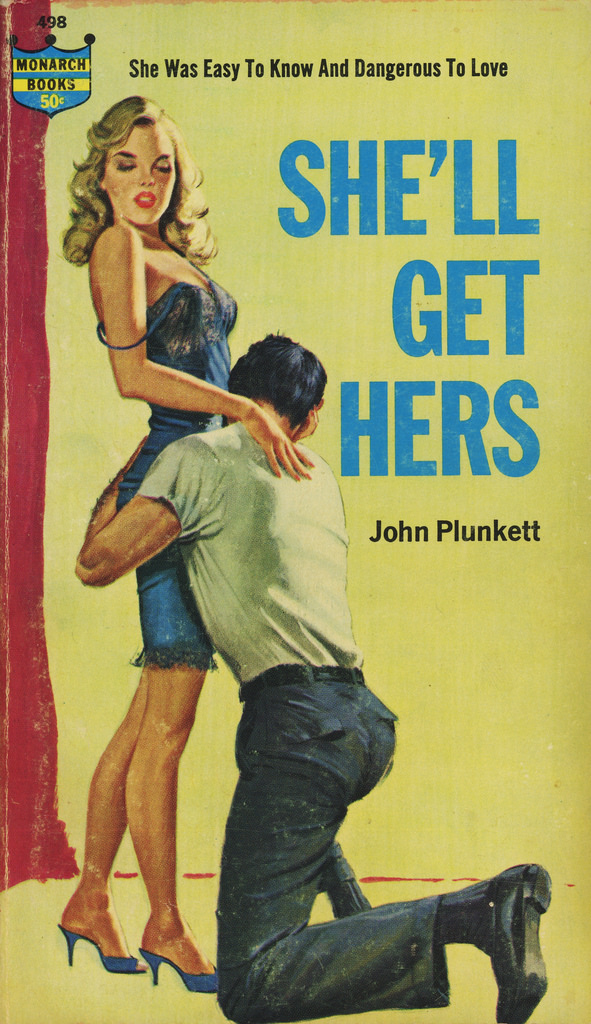
Monarch Books July 1960


Published in 1960 by Monarch Books, She’ll Get Hers is a tawdry little paperback that flies under the wings of some of the better known paperback originals by Gil Brewer and Day Keene and the gang. I’ve read a few Monarch paperbacks and have enjoyed them much like you’d enjoy a burrito from a dirty restaurant. You know they’re bad for you, but you like ‘em anyway. Monarch was kind of a low-rung publisher of pulpy paperback originals, and I’m guessing they went for the sleazier side of stuff than Gold Medal. Judging from the titles in their catalog, lots of juvenile delinquent, beatnik, and sleazy kicks can be enjoyed in these old paperbacks.

She’ll Get Hers is written by John Plunkett. According to the blurbs, Plunkett was heavily involved in the entertainment scene at the time, and sold screenplays for both the television and film industry. I don’t know if She’ll Get Hers was his only novel. It’s the only one I’m finding after a cursory look online. Regardless, it’s an often-told story of a bad guy getting his come-uppance by a bad girl. In this instance, a hood named Marty Koslo, and his new flame, Jo Wilder.

Koslo is an east coast enforcer for the Syndicate and is sent to Los Angeles to get to get to the bottom of why receipts from marijuana sales have dropped in recent months. Los Angeles is familiar turf for Marty Koslo. He’s got a swanky apartment above Sunset Blvd and a hot sexy girlfriend named Lorry Logan. He sets up a meeting with the district supervisors of the organization and reads them the riot act. Their biggest market is in the high schools and colleges throughout the Hollywood area. Koslo lays the tough guy routine down on the supervisors and promises he’ll be following up with the local pushers next. This has the whole L.A. crew in an uproar.

Marty Koslo was not just a successful hood. Marty Koslo was the syndicate’s number one hatchet man. The executioner. The enforcer. Big K, they called him. Not K for Koslo, but rather for Kill.

Later that night, back in his Hollywood office at the Chilton Hotel, Marty Koslo is kicking back with a drink and thinking of his date with Lorry when he’s approached by the bellman, a former jockey named Willie, who puts him wise to a raw deal fixing to happen to one of the regular girls who do freelance “modeling” work in the hotel. Some local Hollywood type named George has paid Willie to supply him with “knockout drops” so that he can score with one of the models who is there posing for “art” pictures. Willie tells Koslo that this particular girl don’t rate such a slimy treatment, that she’s special, that she ain’t like the other girls. He asks Koslo to run George out of the joint on behalf of his unsuspecting victim. Koslo figures what the hell, Willie is a good guy and is obviously sweet on this chick, so he’ll do him this favor. He takes the vial of knockout drops from Willie and goes to George’s hotel room. In it he finds George is all hot and ready for his fun time with the model who is in the bathroom changing her wardrobe. Koslo sends “Georgie” packing. Then he decides that, as long as he’s there, he’ll check out this chick that Willie is so sweet on. And out of the bathroom walks the stunning Jo Wilder.

She stood in the doorway framed by the light of the bathroom. She was wearing a pair of tiny nylon panties, black stilted pumps, a fresh coat of red lipstick and a rather vague expression of mild surprise.

A lot of attention is focused on Jo’s magnificent breasts at this point, and Koslo is basically reduced to a stuttering schoolboy on his first major crush. He lets Jo know that he’s just saved her from a sleazebag whose promises of a career in the movies for Jo was all bullshit. Jo is appropriately grateful, and promptly lets him know that, while she may pose nude for pictures, she’s a good girl who is pure of virtue. She also gets off on Marty’s obvious admiration of her naked body. Marty Koslo asks her if she’s had dinner yet and Jo agrees to go out with him that night.

What follows is a quick courtship of sorts, as Marty Koslo convinces Jo Wilder to come back to has pad above Sunset Blvd that night. A lot of kissing and mushy stuff follows, leaving Koslo’s head spinning under Jo’s alluring spell. She lets him know several times that she’s a virgin, but would like to be his girlfriend. She promises him that she’ll make him happy. Koslo figures it won’t be long before Jo gives herself up fully to his charms. In the meantime he dumps his girlfriend Lorry so he can devote all his energy toward Jo. In a matter of a single weekend he convinces Jo to move out of her dumpy apartment and stay with him. The next afternoon, while helping her pack up her stuff, he meets Jo Wilder’s neighbor, an artist named Mona. Mona seems unusually distressed to learn that Jo is moving out. She’s been painting a portrait of Jo and tells her she’ll have to finish the portrait from memory. Jo Wilder seems oblivious to Mona’s obvious crush on her, and promises to keep in touch with Mona. Koslo doesn’t give a rip about any of that artsy-fartsy stuff, and tells Jo Wilder to never see Mona again.

On the business end of things, Koslo learns that some of the distribution managers have been cutting the marijuana supply with tobacco. The high school kids are complaining that the stuff they’re buying isn’t any good. And the sales are dropping as a result. Koslo is ordered by the bosses back east to terminate the contracts of these managers, and do it with “a lot of noise.” Koslo brings in a 2nd hitman named Tito to help with the job. Meanwhile, Jo discovers the vial of knockout drops that Koslo got from Willie. She accuses Koslo of keeping them to use on her, to take her virginity. She has a complete hissy fit and runs away. Koslo spends the night trying to find her, only to discover that she’s run back to Mona’s arms. He shows up just in time to find Mona diving between Jo’s luscious thighs as Jo is writhing in unbridled passion. No wonder Jo doesn’t give it up for him, he figures. She’s a perverted dyke! In a rage, he beats up Mona and leaves Jo cowering on the floor. Then he and Tito head out into the night to gun down some cheating dealers.

Well, you know how these things go. Koslo’s preoccupation with Jo ends up messing everything up between him and his employers. A hit goes sloppy, a teenage girl is kidnapped, Tito ends up being a perverted psycho, a dealer flips and the police get tipped off to the entire drug operation. In the end, there is nothing left for Marty Koslo to do but go into hiding. But first, he’s gotta win Jo Wilder back!


It’s all a hot mess for Marty Koslo. Jo Wilder is one of those chicks who only live in novels like this. There are a lot of eye-rolling moments for the reader as Marty trips over his dick again and again. Lessons for the rest of us tough guys to be learned for sure; the first one being don’t get involved with bad girls who tell you how good they are. Actually that’s a terrible lesson. Where’s the fun in that?


Sunday, September 23, 2018

Time of the Great Freeze - Robert Silverberg

Jim hoisted himself over the rim of the tunnel mouth, stepped into the new world, and fought back a surge of panic as he saw the magnitude of it all. Even at night, even by moonlight, it was possible to see how the flat ice-sheet spread out to the horizon. It was a numbing, breathtaking sight for anyone who had spent his whole life in tunnels hardly higher than his head. 

ACE Books, August 1980

I read this book while the temperatures outside were pushing the 110 degree mark. The acceptance of global warming, or at least, climate change has most of us wondering what happens to a planet that heats up. This book, written in 1963, takes a look at the flip-side of that theory and sees the world under another ice-age.

I picked this up a couple years ago along with several other science fiction novels by Silverberg. I've come late to the game in appreciating Robert Silverberg's science fiction novels. I don't know how I didn't read his books when I was in my teens and enjoying Asimov and Clarke and others. This book would have been a favorite had I read it as a kid. It was written for the "juvenile" market at the time of its publication, in the days before "young adult" shelves filled bookstores, but I think it's enjoyable at any age. It's a pure adventure story and with nice dollops of science and sociology along the way.

It's a simple plot, the best kind it seems, about a young man named Jim Barnes who, along with a team of explorers lead by his father Dr. Raymond Barnes leave New York to reach London during what they believe is the beginning of a long thaw after a several hundred-years-long ice age. The year is 2650 and New York is now completely underground, beneath miles of ice. After a few hundred years it has become completely isolated, existing on an inertia that its leaders have no desire to see interrupted. After making radio contact with London, Dr. Barnes and his associates believe that the time has come for the nations to communicate with each other once again. Unfortunately, he and his team are arrested and tried for conspiracy for their troubles. The City Council, a group of old men holding on to their power (sound familiar?) decide that, instead of giving Barnes and his team any publicity for their theories, they be sentenced to exile. This leaves our friends no choice but to try and make it across the ice to London, alone.

It's an arduous trek, to say the least, and not everyone will make it through alive. For a "young adult" novel of the time, it's surprisingly brutal and violent in places. I don't think I ever remember anyone dying in a Tom Swift or Hardy Boys book. That's not the case here. Death can strike at any moment as our friends travel in the harsh elements, encountering nomadic tribes and deadly beasts along the way. And to make their plight even more grim, their point of contact in London seems less than enthusiastic that our team of Americans complete their journey.

I thought this was a terrific book for what it is, a pure adventure/science fiction story. It's probably a touch old fashioned however, in that this is definitely a "no chicks allowed" kind of party. But for a couple of hours reading in the dog days of summer, it did nicely.


Friday, April 27, 2018

The Devastators - Donald Hamilton

There was a little pause. I was tempted to add something mushy to the effect that she was a pretty nice kid, after all, and working with her wasn't going to be quite the ordeal I'd expected. While I struggled with the impulse, the telephone rang, which was just as well. I mean this buddy-buddy stuff may be all right in the armed forces, but in our line of work you're much better off hating your partner's guts. Then you won't feel so bad if he breaks a leg and you have to shoot him--and if you think that's just a figure of speech, Buster, I envy you the happy TV world you live in.

Gold Medal Books

Ah yes, that's our hero Matt Helm being as endearing and sympathetic as ever. In this case, the partner he's referring to is another agent in his organization named Claire, or that's all the name you need to know, since Claire's assignment is to accompany Helm to Scotland, posing as Helm's new wife. Helm's job is to follow up on the trail of a missing disgruntled American scientist named Archibald McRow. The previous agents put on McRow's tail have either ended up missing-in-action or have been found dead by means of various illnesses. In one case, the measles, another of chicken pox, and the most recent agent, dying of the Bubonic Plague on a lonely coast of Scotland. Small wonder about the means of death, given that our Dr. McRow has been working on top-secret biological viruses and their antidotes. Helm's job is to draw out the opposing team and eliminate them. Claire's job, or Winifred Helm as she'll be referred to, is to put the touch on Dr. Archibald McRow. Kill him, that is.

My friends, this novel from 1965 is a corker! Helm is barely in London a few hours when an attempt is made on his life by a former soviet agent believed to have been executed. Then his partner, excuse me, his wife I mean, is kidnapped from their hotel. She was last seen by the hotel staff leaving in the company of a lady and another gentleman, both Oriental in appearance. And if that's not enough, an old face from a previous novel, The Ambushers, shows up. It's Vadya, the beautiful and extremely deadly soviet agent, and as it just so happens, Helm's former lover.

If Helm has an equal in the spy game it's Vadya. In The Ambushers, Vadya had a good time torturing Helm with a soldering iron, trying to get the dirt on a mutual target in Mexico. This time she's on the trail of Dr. McRow as well. At least, that's what she tells Helm. He has to torture her with a trick belt first to get anything out of her. In many ways, this novel is a cousin of sorts to The Ambushers, as the events in that novel, two years earlier, are referred to several times. I would recommend you read The Ambushers before reading The Devastators to get the most out of this one.

Anyway, after the torture and sex session between Helm and Vadya is dispensed with, the two of them agree to "team up" to find Dr. McRow. Vadya informs Helm that a certain Madame Ling has kidnapped Claire, remember Claire? and is luring Dr. McRow on the promise of a vast fortune, to lend his brilliant mind to the Chinese Communists. All he has to do is provide the means to kill off most of the planet's population. But like I said, he was disgruntled. And you know you're neck-deep in a spy novel when you have character named Madame Ling!

What follows are chases, shoot-outs, beatings, killings, more torture, more babes, hypodermic needles and rats infected with The Black Death! I'm telling you this novel has the works! I was amused by more of the self-deprecating asides that Helm provides us as he takes us through the plot. I was a bit worried that, after nine novels into the series, I would have gotten my fill (as perhaps some readers of this blog might) of Helm's brutal and hardboiled world. But this book kicked the action up a notch. Here's looking forward to the next novel in the series, The Betrayers.


Saturday, March 31, 2018

Mountain Girls and Swamp Rats


I had to pause in my reviews of the Matt Helm series when I discovered I didn’t have the next book in line. Luckily, finding the books out there isn’t as hard as it used to be. Not sure if anyone cares or not, but I’m having fun going through them from the beginning. Anyway, it’s not like I haven’t been keeping up with other things in the meanwhile.

For example, a couple of old Gold Medal nuggets featuring primitive lusts, passion, greed, gators and girls you don’t take home to mother.

Gold Medal Books and Black Lizard Books


And the swamp continued to rot and to wait for the end, and everything was as it had been in the beginning. - Robert Edmond Alter - Swamp Sister

Swamp Sister, by Robert Edmond Alter, was published in 1966. It’s the kind of novel that’s like sour candy for me. Even the name is irresistible. I don’t know much about its author, but I remember reading Carny Kill some years ago. How is that for another great title? A pair of titles like Carny Kill and Swamp Sister and, brother, you’ve got yourself a fine double feature ahead of you. Both books were republished by Black Lizard Press in the 80’s and shouldn’t be too hard to find now. Swamp Sister sets up a classic plot of missing loot lost in a Florida swamp, a pair of swamp rats with larceny in their hearts, a lusty young man looking for a better life, a sexy babe in cut-offs and not much else, and a crooked insurance investigator, all mixed into a sweaty brew somewhere in the wilds of Florida. The place isn’t specifically named, but I’m calling Florida purely because gators turn up all over the plot as our hero, Shad Hark, navigates his way to the missing payroll loot through a pair of hot sisters named Margy and Dorry, and a couple of murderous swamp rats named Sam and Jort. Seems our pal Shad can’t get a break after he foolishly spends some of the missing loot in the local general store. In no time flat he’s got the whole town all up his ass trying to get their sweaty mitts on that money. It’s a pretty good yarn all in all. My only complaint is the cornpone dialog gets a little weary after a while. A little goes a long way when it comes to people speaking like cottonmouth snakes. But that aside, it is well worth checking out if you have a hankering for a sweaty chick with loose morals sitting on a pile of ill-gotten swag.

“Ben, they’ll kill you for sure. Ain’t nobody around here ever stands up to them. If a man’s too big, they come at him from two sides. They have guns—they’ll use them and they don’t care none if they kill. Please, Ben, let’s get out of here now. I know some of the way—we can guess at the rest.” - Norman Daniels - Something Burning

Promotional flyer found in my copy of Something Burning


Something Burning, by Norman Daniels from 1963, has never seen a reprint as far as I know. I found it in a used bookstore with a small promotional flyer by Barbara Hendra, publicity director with Gold Medal at the time, asking for a review. It’s a neat little artifact folded into the pages of the book. I don’t know anything about writer Norman Daniels, but see that he’d written some westerns back in the day. Something Burning could easily have been a western as well. Ben Medford, our lead protagonist, is deep in an alcoholic state of mourning for his recently deceased wife, Sandy, and winds up wrecking his car off a mountain road one night. He’s found by a mountain girl named Ora and is nursed back to health. In the process of recovering, he and Ora are confronted by a pair of mountain hillbillies named Roy and Joel Gallison. Roy and Joel are right out of a casting call for Deliverance, as they take pleasure in killing and raping whomever they please. Ben uses his anger and screw-it-all attitude to his advantage and beats the hell out of Roy and Joel. Unfortunately he lets his civilized upbringing get the better of him and doesn’t kill the brothers. Bad mistake! The brothers return and kill Ora as she and Ben attempt to leave their mountain hideaway. Now Ben is on the run, blamed for Ora’s death and for setting a string of recent forest fires as well. He’s an outsider stripped of civilized mores, dealing with psychotic hillbillies and firebugs as he attempts to make it out of the mountains alive. Halfway through the novel, it changes course and becomes a stranded survivor plot as Ben and others are held hostage by the real firebug in a lookout tower as the flames surround them. It’s not a perfect novel, nor a lost classic. There are some lapses in logic happening, and Ben’s sudden attraction for another mountain girl so soon after the death of his wife doesn’t make a lot of sense, but all in all, Something Burning was an entertaining way to pass a few hours. That said, I wouldn’t necessarily go out of your way to find this book. But if you see it out there, it’s probably worth a couple bucks of your hard-earned dough.

So that’s about it for missing a couple weeks. I’ll probably be back in Helm’s world. Who knows?

Sunday, January 21, 2018

Megan Abbott and Gil Brewer Double-Shot

Really, if they're going to wear those darted sweaters tucked tight in those long fitted skirts cradling heart-shaped asses, skirts so tight they swiveled when they walked in them, clack-clack-clacking away down the hall, full aware - with full intention - that he was watching, even as his face betrayed nothing, not a rough twitch or a faint hint of saliva on his decidedly not-trembling lip. It wasn't he who was unusual, so lust-filled or insatiable. It was they who packaged themselves up so pertly for utmost oomph, for him alone, really, even if they hadn't met him yet when they slid on their treacherous gossamer stockings that morning, even if they hadn't known why they straightened the seams on their blouses so they'd hang in perfectly sharp arrows down their waiting, waiting breasts. - Megan Abbott, from The Song is You

Simon & Schuster Paperbacks, cover design by Ellen R Sasahara

Man, if that doesn't pull you in, you need to check your pulse to see if you're still alive! Passages like this one from The Song is You are why Megan Abbott is one of my favorite writers. She can nail the menace and sex that noir is built on, and transcend it to another level. It's not a surprise that her popularity has increased with each new novel. For every half-baked bestseller touted by critics, there are novels by writers like Megan Abbott who've already done it and done it better.

The Song is You is her 2nd published novel, from 2007, and it uses a real-life Hollywood mystery for its inspiration. In 1949, starlet Jean Spangler left her home to do a "night shoot" for a film she was supposedly working in. She never came home, and was never seen again. A few days later her purse was found in Griffith Park, with an unfinished handwritten note inside it. The note was addressed to a Kirk and referred to a Dr Scott. That was the last clue to a mystery that has never been solved. Megan Abbott uses this setup to recreate a dark novel of secrets about what might have happened to Jean Spangler. It's similar to James Ellroy's novel The Black Dahlia, in that it blends real life people with fiction and recreates a time and place built on dreams and fantasy. I mean who can resist a Hollywood mystery? Abbott's attention to detail and character drives this novel. If you're a fan of noir and unsolved mysteries, this novel will be right up your dark alley. Abbott returned to another true-crime case a few years later with Bury Me Deep about the Winnie Ruth Judd murders in 1930's Phoenix. The noir genre is so heavily weighed down with scads of male writers and tropes that have become so standard as to be expected. Diving into the dark heart of noir from the woman's perspective is a blast.

Gold Medal Books, 1951

Picture in your mind all the wizened, jittery, pasty-faced, hollow-eyed dope fiends you can conjure up, and add ashes. There you have the little guy. Maybe that doesn't do him justice. He was no dope. It was something else. You might think of leprosy when you saw the way his skin glistened, but you'd know you were wrong. He was drumhead tight, in a wasp-waisted gray gabardine that was neater than any pin, with a maroon tie and a maroon handkerchief cocking a bloody eye out of his breast pocket. He wore an expensive Panama hat that must have been set on his square little head with a carpenter's level. It was the broad-brimmed kind. He gave you the impression that when his suit went to the cleaners, he stayed in it, with through the process, pressing and all, and was carefully hung in antiseptic shade. - Gil Brewer, from So Rich, So Dead

The only thing missing from that description are the pink shoelaces! Gil Brewer is one of my all-time favorite noir writers from the 50's and 60's. He's not as polished as writers like John D MacDonald, but his prose has a fever and a drive that make his books irresistible to me. Unfortunately, So Rich, So Dead, from 1951, isn't one of the better examples of why I like his work so much. This was his 2nd novel with Gold Medal, after Satan is a Woman and before his highly successful 13 French Street. All three of these novels were published in 1951, which gives you an indication of his writing method. That was, churn them out and cash the checks. So Rich, So Dead has elements of the best of his novels, found in books like The Vengeful Virgin and The Red Scarf, but falls short, with it's Chinese Buffet of a plot that's almost zany instead of suspenseful.

Briefly, Bill Maddern returns from Charleston, SC to St. Petersburg, FL upon receiving a desperate telegram from his brother Danny Maddern. The brothers had set up a detective agency in St. Pete, and had seen a moderate level of success before, for reasons never really clear, Bill took off for Charleston. In his absence, Danny is hired to investigate a missing person believed to have been involved in a payroll robbery that netted the criminals $500,000. Bill returns to FL to discover his brother's murdered body, along with a note (hidden in a spittoon!) informing Bill that Danny had found the stolen loot and the body of one of the criminals involved. This kicks off a plot that is all over the map in the span of 24 hours, filled with 3 femme fatales, razor wielding goons, shotguns, car chases, angry cops, sex and a wild chase through a lady's department store sale, of all things. It's a fun novel, but not one that I would introduce to first-time readers of Gil Brewer. I'm glad to see that Brewer's novels and stories have seen a renewed interest though.


Friday, December 22, 2017

Brett Halliday - Marked for Murder

Shayne's wide nostrils flared and he felt a prickling in the back of his neck. He pushed the bedroom door wide open, turned on the light, and looked somberly down at the corpse of a young girl lying half off the bed. She wore a pair of black net stockings, the tops rolled above her knees. The rest of her slim young body was nude. She lay on her stomach with her right arm and leg trailing off the bed, her left leg stretched straight and taut with the toes pointing toward the footboard. Her left arm encircled a pillow, and there was dried blood on the pillow and on the sheet beside her breast.


Dell Books June 1959 - Cover by Robert McGinnis

Okay, I'm a sucker for paperback covers featuring beautiful women, especially ones painted by Robert McGinnis. There are tons of Mike Shayne novels with McGinnis covers, and I have a couple others on my bookshelf. In the 60's and 70's the Shayne covers were often photos of hot babes, in various states of undress, typically wielding a gun. These were never as cool as the McGinnis covers, for obvious reasons. As far as the Mike Shayne novels themselves go, they're perfectly serviceable reading if you're in the mood for a private eye novel. I've only read a few and the things I take away from them is that for a private eye, Mike Shayne is as famous as your average celebrity, and he drinks a shit-ton of brandy. Most P.I.'s drink bourbon, or scotch. but it's brandy for our pal Shayne. And he's hot with the ladies too. He's also smarter than the cops, particularly Peter Painter, the Miami Beach police chief. But all in all, he's a decent Joe to have in your corner.

This is an early Mike Shayne mystery, going clear back to 1945. By then he was famous enough to already star in a handful of films from 20th Century Fox. He'd also star in radio and TV, and scads of more novels. I noticed that there are a lot of them available on Kindle, but I prefer the old paperbacks, for obvious reasons. Anyway, this is, I believe, the 12th novel in the series, and written by Davis Dresser. Ghost writers under the Brett Halliday name would take over the later novels.

In this one, Mike Shayne is called back from New Orleans to go after whoever it was that shot his reporter pal, Timothy Rourke. Rourke had been hot on the story of a series of murders where the victims had all recently struck it big at various casinos in Miami Beach. All of the casinos are run by the syndicate, in particular a hood named Brenner. Each of the victims was found with a .32 slug in their heart only hours after being seen in the company of a hot blonde dish at the casino. Rourke's crusade has everyone pissed off at him, the cops, Brenner, and Rourke's boss Walter Bronson. Rourke is warned off the story and given a beating by Brenner's thugs, and is found a few hours later in his apartment, near death from, you guessed it, a bullet to the chest. And wouldn't you know it, the last person seen leaving his apartment was a hot blonde babe!

This novel was a fast read, well-paced and with enough twists and angles to never get boring. And, as Shayne himself says a more than a few times, "There are too many blondes!" Yeah...I don't know if you can ever have too many blondes around. Just as long as none of them are packing a gat, I'm okay with it.


Friday, November 24, 2017

Holiday Stuffing

With the Thanksgiving holidays on us, and a few long weekends between my last post, I had a chance to get some reading done, in addition to the full-time day job I’m chained to.

For non-fiction, I finished The Long Gray Line by Rick Atkinson. This book details the lives of various graduates of the West Point class of 1966, from their first year at West Point, through their experiences in Vietnam and after. It’s a long book and painful in many parts. America was an ugly place then. Still is in many ways. I’m not sure we’ve learned any lessons from the past and often wonder if we’re cursed to run in place on a hamster-wheel of folly. 

So, on to the more fun stuff. In addition to the West Point book, I read a cool little sleaze paperback from Monarch Books, Tropic of Cleo by Rick Holmes. I spent a Saturday afternoon manning a market stall reading an old Avenger paperback, River of Ice by Paul Ernst, under the house name of Kenneth Robeson. And lastly, a pretty cool crime novel from the early fifties by Wade Miller called The Big Guy.


The Big Guy is a morality tale of sorts about the rise and fall of a small time hood, Joe Drum, into the top ranks of the Los Angeles underworld. If you’ve seen the movie Scarface (either version) you have a pretty good idea what’s in store for our anti-hero Drum. He’s a single minded beast, (even his name is symbolic for the loud storm from a hollow instrument) whose drive takes him to the top of the game. Unfortunately, when you’re at the top there is only one direction you can go. And man, does he go, thanks to the help of a woman named Patience. There are a lot of nightclub scenes, party scenes, gun-play and betrayal going on throughout, and you read along waiting for the fall of Joe Drum. There is a neat psycho-sexual warfare going on that plays a huge part of Joe’s demise. This is the 2nd novel by Wade Miller (in reality, two pals named Robert Wade and Bill Miller) that I've read after Kitten with a Whip. The style is on this side of over-written, at least in this novel, but once the story hits its stride it moved at a good clip. If you're interested in trying any Wade Miller novels, Stark House Press has reprinted a few of their novels, and used copies of their paperbacks are fairly easy to find. 


Tropic of Cleo is one of those “treasure hunt” capers that could have been written by Gil Brewer. Harry Gregory and his wife Cleo arrive in the Bahamas to meet “an old college friend” of Harry’s. Right off the bat we learn that Cleo has a raging case of the hot pants and you know that wherever she goes trouble will follow. Cleo comes across as bitchy, bored and alcoholic, and enjoys needling Harry at every opportunity. Harry’s pal, Gene Freeman, arrives, along with Max Heinrich and the three of them begin making their plans. Heinrich is a former WWII P.O.W. who holds the secret location to a treasure trove of stolen loot worth about 2 million dollars in his brandy-addled head. The problem is that he doesn’t know exactly which island the loot is buried on. Cleo thinks the whole thing is hooey and isn’t shy about letting the guys know her opinion. She’s also got Gene Freeman all in a lather for her. Freeman makes no bones about putting the moves on Cleo every chance he gets. Enter the picture a seaman for hire named Casey Stribling and Marla Keever. Casey and Marla had a thing going, until Casey got tired of Marla. Casey is one of those golden sun-god types that gets Cleo’s temperature up, and next thing you know, you have a boatload of bottled-up passions and lusts ready to explode. This is the kind of plot where the idea of stocking up supplies means having plenty of hooch on hand to guzzle. There are a couple hot-sex scenes going on and one wild catfight. This is not the kind of stuff that would not find a reputable publisher today. I enjoyed Tropic of Cleo for what it was, a politically incorrect, sexy (for its time) caper with plenty of booze and duplicity and assorted shenanigans going on. I’ve never read a thing by Rick Holmes before, but it was right there in the Gil Brewer style of writing to keep things from ever slowing down, forcing you to think too much about the preposterous situation the gang’s all in. 


Finally, a quick look at The Avenger: River of Ice. This was the 11th Avenger adventure, first appearing in July 1940. These pulp novels were reprinted in the 1970’s by Warner Paperbacks. I remember seeing them all the time in the Waldenbooks at the mall when I was a kid. They were right there alongside the Doc Savage novels that usually got my 75 cents at the time. I’ve read a lot of Doc Savage novels over the years, and only a few Avenger novels. I’m going to have to say it. The couple of Avenger novels I’ve read were better than many of the Doc Savage novels I can think of off the top of my head. That's probably fightin' words among pulp nerds! I understand that The Avenger was a response to the success of both Doc Savage and The Shadow. Paul Ernst was hired to write the early Avenger adventures after consulting with Walter Gibson and Lester Dent, authors of most of The Shadow and Doc Savage novels, respectively. The Avenger is an adventurer named Richard Benson who turns to fighting crime after his wife and daughter are murdered. The shock of their deaths turns Benson’s face and hair a ghostly white. His features are also paralyzed. This allows his face to become malleable, thereby providing ample opportunity for disguise. He’s kind of like Doc Savage, The Shadow and Batman, in that he has an arsenal of gadgets and chemicals at his disposal. He also, like Doc Savage, does not kill criminals; instead he allows them to kill themselves by their own actions. This adventure has a lost civilization theme to it, wherein a gruesome surgical method for creating obedient slaves by sticking a steel needle into the brains of people is used as a plot device. There are chases, fights and perils aplenty in this romp, including a not particularly difficult mystery about who the evil genius is causing all the turmoil. It’s nicely paced, keeping up a lot of suspense right up to the ending. I would imagine that Avenger paperbacks are relatively easy to find out there in the wild. I mostly see Doc Savage paperbacks but every so often an Avenger book shows up.

So that’s about all for now. Happy hunting. 

Monday, November 6, 2017

Never Die Alone - Donald Goines

It seems as if half of Los Angeles' finest detectives raided my old apartment. Now I'm not sure it's related to the trip that Billy made. I can't think of any other motherfuckin' reason for the police to come storming into where I had lived. From the information that I have been able to gather, the boys in blue were put out because I hadn't sat still and waited for them. If it hadn't been for me using a little foresight, I think I would have been behind bars at this moment, instead of writing these notes down. 

Holloway House Publishing Company, cover photography by Jeffrey
The only thing that Donald Goines was missing was an editor. His novels were written, according to sources I've read, to support a drug habit, and were churned out in first drafts and sold at a furious pace to keep his demons at bay. I've read a handful of his novels over the years and have liked every one of them, but finish them wishing that someone had tamed the force that produced them. But perhaps they wouldn't have that voice and grit that make them urban fiction classics. That voice! In the space of 4 years, from 1971 to 1975, he published 16 crime novels. In 1974 he was gunned down in his home. The person(s) responsible have never been determined.

Goines wrote of the life he lived as an addict and people he knew. Never Die Alone is sort of all over the place, but has a way of holding up by its own narrative drive. It begins with a young writer, Paul Pawlowski, preparing to go to a job interview for a "leftwing" newspaper. We're given a lot of detail in Paul's ancestry that is never part of the plot. In the second chapter we're introduced to King David, known on the streets as King Cobra, who is returning from 5 years in California. King David left New York owing money to a lot of bad characters, including a small-time gangster named Moon. Arrangements are made for King David to pay Moon back, with the understanding that Moon will not sic his henchmen on David. Moon agrees, figuring that he'll let an up and comer in the underworld named Mike take care of King David after collecting the money owed. Mike has personal reasons for getting even with King David, because David once robbed his mother of her government check and beat her and him with a Coke bottle in the process. King David was a pusher and con artist, who has left a trail of junkies and victims in his path.

Of course, as things always do in crime novels, things get fucked up really fast. King David survives the sloppy hit job on him, barely, leaving one hoodlum half dead with a knife wound to his eye and witnesses, including Paul Pawloski and Mike's sister, Edna who was used as a kind of honey-trap on David. Paul manages to get King David to a hospital before he succumbs to his wounds. David's last request to the doctors in the hospital is that Paul inherit his Cadillac and all his possessions in it, including a journal that he kept of his time in California. Meanwhile, Moon is frantic that the botched hit on King David is going to bring the heat down on him. He sends out more henchmen to eliminate Mike and Edna. Well...you guessed it. That hit goes down bad as well. Edna is murdered, but Mike manages to kill Moon's flunkies in the process. All of Moon's henchmen are terrible shots, and that while people get killed, it's never the right people. Now Mike, bleeding from his wounds, is coming back for Moon. Meanwhile, Paul is home in his apartment reading King David's journal of his time in Los Angeles living in hotels and pushing heroin while passing it off as cocaine. David has affairs with a couple of young women who find him more customers looking for kicks. In the process, he falls in love with a girl named Juanita, who spurns his offers. She'll take his coke, but she ain't about to shack up with no two-bit jive-ass pusher and con man. Bad, bad move on her part as we'll learn.

King David's journal serves as sort of a novel within a novel, as it's presented as it was written by King David. We learn really quickly that King David was a monster, double-crossing and betraying just about anyone unfortunate enough to cross his path. I wonder if Goines had intended this journal to be a novel on its own, but got hemmed in by the first person point of view, then built the characters of Paul and Moon and the New York scenes around it instead.

Of course, there is no telling. So, in the end we have a flawed, but in its own a way a brilliantly flawed, novel of pimps and pushers and...writers! Strange brew and not for the timid. This novel gets violent and nasty before things come to a resolution.

In the end, I give it a recommendation. If you find any of Goines' novels out there, check them out.

Sunday, October 15, 2017

It Came from the Drive-In

Betty Jane screamed and struggled to no avail against the brutish SS guards. "You'll pay for this! I'm a cheerleader at Denton High!"  

In a moment Betty Jane was stripped down to her white cone-shaped bra and panty-girdle and beige stockings. Flicking her riding crop, Elsie walked about her, studying Betty Jane closely. She playfully tugged at Betty Jane's blond ponytail.   - "Plan 10 From Inner Space" by Karl Edward Wagner

DAW Books February 1996. Cover by Vincent Di Fate

Yikes! Poor Betty Jane! I hope her boyfriend can rescue her in time before those evil Nazi bastards have their way with her!

So being the right time of the year for completely over the top horror fun, It Came from the Drive-In, edited by Norman Partridge and Martin H. Greenberg (what anthology didn't this guy edit?) provides more than a fare share of the stuff your grandmother warned you about! This was one of those perfect anthologies that screamed at you from bookshelves of your favorite bookstore twenty-some years ago. Every story in this collection is a lurid homage to those awesome drive-in movies last seen sometime in the late seventies before video rental stores moved into the strip malls.

With titles like "Die, Baby, Die, Die, Die" and "The Blood on Satan's Harley" and "The Good, the Bad, and the Danged" you're guaranteed to find something you're not supposed to like in this collection. Partridge and Greenberg put together these all original stories in the true spirit of grindhouse glory.

Horror sometimes takes itself a bit too seriously, and my biggest gripe against it these past few years (decades!) is that it's lost its mojo. It's supposed to be like a carnival ride, like candy that rots your teeth. Horror is supposed to be that girl by the lockers who smokes Marlboros while mocking the kids on the football team. And the scruffier, naughtier and sexier, the better as far as I'm concerned. That's the stuff that pulls me in. I know a ton of people will probably disagree with me and that's cool, but I've always looked for the strings dangling that rubber vampire bat and skeleton instead of something that's just there to depress me or gross me out. These stories by Ed Gorman, Nancy A. Collins, Norman Partridge, etc. take that spirit of horror/science fiction and make it fun. It was this kind of spirit that...(shameless plug coming up!) I wrote my first published novel, SIRENS, with. Whether I succeeded or not is up to readers, what few I get, to decide.

I'm glad to see that this terrific anthology hasn't disappeared, as it looks like copies are still available out there. Short stories this fun are getting rare and it's my hope that their spirit keeps rattling those rusty chains in your attic for a long time to come.

Sunday, October 8, 2017

The Landlady - Constance Rauch

"Ugh. How in the world did we come by this?" Sam's revulsion was as instinctive as Jessica's. The doll was made of aging, half-sticky, half-dry and corroded latex stretched over a spongy composition frame, its "skin" luridly jaundiced. It was, admittedly, a slightly naughty toy. Perhaps a novelty item sold by mail through the pages of a bygone stag magazine some thirty or forty years earlier. Its head was disproportionately larger than its body. Though it may at one time have had some kind of "human hair" wig, all that remained on the scalp was a multitude of pinholes, thus making its encephalitic head look like the work of some mad acupuncturist. The facial features, those of a coy, Kewpie doll, wore the plucked eyebrows and ruby-red cupid's-bow lips of the late twenties and early thirties.


Popular Library, June 1976


Well, it's the right time of year to read creepy novels and there are are few things scarier to me than creepy dolls. I'm also often creeped out by mannequins and ventriloquist dummies for that matter. And clearly I'm not alone since there are plenty of spooky movies and stories that feature creepy dolls. Much scarier than bizarre clowns holding balloons if you ask me.

I consider myself a pretty good horror fan, knowledgeable in all the classics and much of the obscure horror flicks and lit that is out there. I've seen a lot of movies, read a lot of books and have come to the personal opinion that most of contemporary horror fiction and film doesn't do much for me. Somewhere after the end of the 80's, horror took a turn for the formulaic gross-out, featuring serial killers for a long time. Then came the zombie apocalypse which seems to have over-run the horror market, much like elves and dragons took over the sci-fi market back in the seventies. There isn't a lot that I, as a horror fan, can turn to now that satisfies me the same way as staying up until after midnight to watch a scary movie on my old black and white TV did when I was a kid. So, when it comes to nourishing my taste for "horror" now, I mostly end up looking backward into the dusty paperbacks and movies of the past. Admittedly, most of it isn't scary, but there was a sense of spirit and soul to the movies and novels that I find is mostly (I'm not saying all) missing today.

Anyway, this is all a long-winded approach of setting up my thoughts on The Landlady, by Constance Rauch, published way back in June of 1976. I have to thank Will Errickson and his stellar blog Too Much Horror Fiction for re-introducing me to this one. Will is a far better reviewer of vintage 70's and 80's horror fiction than I am, so I encourage everyone to check his blog out. Oh yes, and while you're at it, if you're a fan of vintage horror do not miss Paperbacks From Hell.

I totally enjoyed The Landlady and blasted through most of it in a single day. It's very much a novel of its time (mid-seventies) providing a look into the social fabric of that decade with regard to marriage, class division, and manners. Jessica and Sam Porter and their infant daughter, Patience, move into an apartment in Wimbledon, New York, renting a section of a large house from eccentric old Mrs. Falconer. The setting is an obvious nod to The Stepford Wives and Burnt Offerings. The suburbs have proved a fertile inspiration for many horrific events, and the characters in Wimbledon give sly acknowledgement to such. I was also reminded of the Oxrun Station novels by Charles Grant. Jessica and Sam are clearly in a troubled marriage right from the get-go, and the meddling Mrs. Falconer wastes no time in pouncing on their fragile bond. Their home seems an open door to creepy goings on, including the discovery of a disgusting (and you'll learn just how disgusting) doll described above. Soon enough, Jessica learns that Mrs. Falconer has a long history and reputation of being a terror on her tenants. Locals look at the Falconer residence as a place of bad juju with a sordid past. Sam disappears into the city for long absences, leaving Jessica alone to deal with the paranoia surrounding their apartment. There is also the murder of a well-liked spinster in town that features prominently in the novel. Things get weirder and scarier for Jessica and Patience as events are piled on in thicker slabs of terror.

Readers today will have to re-adjust their expectations in taking on The Landlady. The climax will likely come off as ludicrous and the pacing may be too slow for many. The characters have a tendency to speak in well-mannered monologues that one would likely never hear today. But putting these minor critiques aside, I thought the book was a pretty good time. It's well written and has a way of pulling you into the plot once you give it a chance.

Friday, September 29, 2017

The Price of Murder - John D MacDonald

It did not take him very long. Nerve centers and pressure points are much the same for a woman as for a man. With the flood of genuine agonizing pain came a fear that oiled her face and turned it gray. He had her in a corner and he made the words tumble out of her, a gasping torrent. Then, holding her arm, he walked her gently to the big bed. She walked with the feeble fragility of a very old woman. When the pain had faded, he made her tell him again, and asked her questions until he was certain he knew all she knew. The harsh discipline had shocked her. It made her very meek and highly affectionate. It restored him to the place of dominance. 


Fawcett Gold Medal

That's an interesting passage from The Price of Murder by John D. MacDonald in that it illustrates one of several times that women in this 1957 novel expect and get off on male domination, whether emotional or physical. In fact, none of the women represent well in this novel. I think it's more due to the genre and the times than any misogynistic attitudes by MacDonald. I've read almost all of his novels and there aren't many where you'll find an independent, strong female character that isn't a femme fatale or an insane nympho. Otherwise, women are good good girls who are expected to make good wives and mothers. Perhaps it's something that male readers expected. But I get why female readers wouldn't appreciate the books now. Even the Travis McGee novels have dated badly when it comes to attitudes towards women. I'm not knocking the book for it, it's just something that is pretty jarring reading today. Not that we don't still have a long way to go in 2017, but that's another lecture for another time. Still, it's fun to climb into the heads of the girls gone wrong in these books.

The Price of Murder is an excellent example of character studies wrapped in a crime novel, something MacDonald was very good at. Most of the first half of the book is a series of backstories for our starring roles. We have Lee Bronson, a college English instructor and war veteran. His brother Danny Bronson, a three time loser and small-time hood with a history of bad luck. And making their lives hell is one of those terrific JDM villains named Johnny Keefler, a sadistic parole officer with a prosthetic hand and a maniacal hatred for anyone who has broken the law. Lucille Bronson is Lee Bronson's wife. She's described as a "silky and membranous and pneumatic little trap." In addition to Lucille, there is Drusilla Catton, a "dark, reckless, full-bodied, hot-blooded" woman who has no issue flirting with danger and trouble when it comes to men.

A couple of people get brutally murdered in this novel, and you'll have no trouble guessing who two of them are out of this small cast I've given you. The main plot concerns a recovered stash of ransom money that Danny Bronson has a chance to get his hands on. Unfortunately, the ransom money is tied to a foiled kidnapping and murder case of a pair of wealthy twin boys that happened years earlier. Danny Bronson only learns about it from his time screwing Drusilla Catton, who happens to be married to a failing (and ailing) businessman named Burt Catton. Burt Catton's pal and lawyer, Paul Verney, is offered a chance to purchase the several hundred thousand dollars of ransom money at a deep discount, with the intent to launder it and save both him and Catton from financial ruin. Danny Bronson intends to extort the whole boodle from them and head south of the border. Hot on Danny Bronson's trail is the psychotic Johnny Keefler. Making things worse is that Danny makes the fatal mistake of trusting his sister-in-law, the bored and restless Lucille Bronson, with his plans.

This novel rips along nicely and the early backstories only intensify the motives and drives of the characters involved. I read it in two days while prepping for a medical procedure and it was a nice diversion. My only complaint, and it's a common issue I have with some of MacDonald's books, is that in the final thirty pages or so you can see him trying to wrap everything up into a complete and final resolution. Some of the later McGee novels don't aim as hard for this as the early non-McGee novels do. But that's a minor quibble in what are some really terrific crime novels by one of my favorite writers. This one can be found easily used or for your Kindle.

Sunday, July 16, 2017

The Long Wait - Mickey Spillane

Wendy was a pretty little head, all right. A little on the hard side when you looked close and the make-up didn't take away the brittle lines that were etched in the corner of her mouth and eyes. She was a million bucks in a green dress under artificial lights and two million in bed. A dime a dozen in the daytime though. 

Signet Books 
Oh snap! That's a mean thing to say about Wendy! But that's how it goes for dames in Mickey Spillane's world. I'm trying to remember now if any of the dames in this novel were called Kitten. I don't think so. That's a name Mike Hammer uses for his babes. And as most of you probably know, Mike Hammer ain't in this hardboiled soap opera from 1951.

As plots go, this one features the old reliable amnesia gimmick for its fuel. Our hero, Johnny McBride returns to Lyncastle, a burg a couple connections from Chicago, to right some wrongs and clear his name. In order to accomplish this, he promises the reader that he's kill someone, break someone else's arms, and a third person will "get a beating that would leave the marks of the lash striped across the skin for all the years left to live." Oh and that last one is a woman. So yeah, Johnny McBride ain't fooling around!

So Johnny pulls into town by bus on the first page. Next thing he knows he's getting the bum's rush by a copper. But Johnny's planned ahead. His plans and a nice fat roll of dough get him into a swanky hotel. But it's not a day he's in town before he's hauled in by the cops for murder. This is after a couple of punches get thrown and someone gets kicked in the stomach and pukes and another gets a belt in the teeth and...well, after things settle down, the cops are dismayed to learn they can't hold Johnny for squat because he's got no fingerprints. That's right, he's got no fingerprints!

Did I mention this novel is one loopy ride? Didn't the amnesia hint give that away? Well trust me, it's a doozy, because Johnny McBride really isn't really Johnny McBride. He's really a guy named George Wilson, who was a pal of the real Johnny McBride after Johnny went on the lam for being accused of stealing $200 grand from the bank he worked at in Lyncastle. In addition to robbing the bank, he was also accused of gunning down District Attorney Bob Minnow. It seems McBride was believed to have killed Minnow because Minnow was going to arrest him for the bank theft. So after shooting DA Minnow, McBride hauls ass out of Lyncastle for parts unknown. But first he leaves the gun with his prints all over it at the murder scene. So, you'd think that is it for Johnny, only now, the cops can't hold him for murder because he doesn't have fingerprints anymore. So they have to settle for tailing him around Lyncastle as he tries to clear his own name.

Yeah, you kind of have to forgive a lot of stuff that makes no sense to enjoy this novel. Anyway, George Wilson, now assuming McBride's identity (because he's McBride's exact double and all) gets dope on a cat named Lenny Servo, who seems to deal all the cards from the stacked deck in Lyncastle. There's also a missing chick named Vera West, who was Johnny's girlfriend and coworker at the bank Johnny supposedly robbed. Johnny's after Vera because he's convinced that Vera had him set up for the bank job because afterward Vera hooked up with Lenny Servo. All this background stuff is revealed through a bunch of punching and teeth-kicking. And with people taking potshots at Johnny whenever suitable.

The novel is violent as hell and moves at a crazy pace. Johnny gets beaten up a lot and has a lot dames throwing themselves at him all the while. It's exactly what I would expect when I open a Mickey Spillane novel. You're going to be entertained and given your $1.95's worth. And you know you like this stuff anyway. Who wouldn't?


Saturday, July 8, 2017

Fadeout - Joseph Hansen

The wire mesh fence slumped as if the signs were too heavy for it. At one point it lay like a rusty circus net. It sprang like a circus net when he stepped across it. In the shadow of the Chute he found the place where Fox Olsen had died. Crude chalk outline on the planks....In the stinking dark forest of splintery posts under the pier lay pizza tins, beer cans, cigarette wrappers, condoms--the joyless detritus of American joy. 

Owl Book Edition 1980
I've heard good things about the Dave Brandstetter series for years and I own a couple of the early ones thanks to used book sales around the town. Some years ago I lent the whole set I had to a friend who was moving to Mexico. Since then I've got them all back and none the worse for wear. It's good to have friends who take care of books. Anyway, I finally read the first novel in the series by Joseph Hansen and am happy to tell you the good things I've heard were justified.

This isn't your standard California detective mystery, as the blurbs on my edition would have you believe. One even refers to Hansen as "a worthy successor" to Hammett. Well, Hansen and Hammett have names that begin with H, but that's about it for comparing the two as far as I'm concerned. This is a moodier, measured novel than Hammett's novels are. Dave Brandstetter is an insurance investigator, not a private eye, and is mourning the loss of a loved one as the novel begins. You don't get the feeling that Brandstetter is a "shoot first and ask questions later" type of guy.

The mystery concerns a missing person named Fox Olsen. It appears, to Brandstetter anyway, to be a staged car accident off a bridge in the rain instead of accidental death. Something just like the cover shows above. No body is found and before any life insurance is going to be doled out to the beneficiaries, Brandstetter has to verify that our missing and supposedly dead Fox Olsen isn't trying to pull a scam for the insurance money. Still, Olsen seemed happy enough, and successful enough in town with his popular radio show. So why take the fade-out?

The more Brandstetter probes the life of Fox Olsen the deeper things get. For one thing, Fox Olsen was a frustrated artist and writer. Add to that a marriage that harbored infidelity. To further complicate matters, an old friend of Olsen's returns after 20 years to rekindle a relationship the two had before Olsen joined the Air Force.

The novel was published in 1969, and I would imagine the gay themes, in addition to a gay detective protagonist were pretty controversial at the time. The mystery of the relationship doesn't take long for Brandstetter or the reader to figure out, especially to a modern reader.

I liked the novel and would recommend it to readers who enjoy the Lew Archer mysteries. Also for readers who don't mind a more poetic depiction of a time in California that you don't see in 60's news-reels. I have the next four novels in the series and am looking forward to reading them. I understand that the as the series progresses so does Brandstetter in age and maturity. I believe they're still in print and available in e-format. I also see that there is a single edition of all twelve Brandstetter novels available through third-party sellers, but the price is a bit steep for that one.

Saturday, December 31, 2016

Savage Night - Jim Thompson

That was the week that Jake tried to frame me.
It was the week he tried to kill me.
It was the week Fay and I began brawling.
It was the week Ruthie...
Jesus! Jesus God, that week! Even now--and what do I have to worry about now?--it rips the guts out of me to think about it.


Black Lizard Books, 1985
It sounds like Hell Week, sort of.

I thought it appropriate to blow out 2016's posts with a psycho-noir masterpiece, Savage Night by Jim Thompson. I picked up my Black Lizard edition of this novel about 30 years ago from a store long since closed. Like most of us, I discovered these noir classics through Black Lizard reprints. Same thing with Harry Whittington and Dan J. Marlowe. Several years later Black Lizard was picked up by Random House and the novels were re-issued in trade paperback at a price of $10 instead of $3.95, which kind of sucked for readers at the time. But that's how the publishing world goes.

Anyway, I thought it would be fun(?) dipping back into the paranoid psycho-sexual nightmare of crime and madness that Jim Thompson was so good at bringing to the page. This one, from 1953 follows a hitman named Charlie Bigger on assignment to rub out a potential mob witness, Jake Winroy, before Winroy can testify and bring a whole heap of trouble down on men of influential standing.

Bigger comes to the town of Peardale in disguise as a student attending a teacher's college. He's been hired to kill Winroy before his trial date. His orders are to make the hit look like an accident. Bigger's boss is a shadowy kingpin referred to only as The Man. Charlie Bigger cuts a strange figure as a hitman. At barely 5 feet tall, bad teeth and poor eyesight, he hardly presents an imposing figure of menace. Lifts in his shoes, contact lenses and dentures help somewhat. Years of being called Sonny, and treated like a boy by women have hardened Bigger into something of a time bomb. Our only background on Bigger's violent life is given to us through an article in a True Detective magazine, much like the kind Thompson himself used to write.

Bigger is no sooner in town and taking residence in Winroy's home as a student boarder when he's in deep with a couple of unsettling dames in Fay (Winroy's wife) and Ruthie, Ruthie is another student, hired by the Winroys to come in and clean up house a few hours each day. Ruthie has an unsettling deformity which Bigger finds both horrifying and appealing. He relates to Ruthie as a misfit. Fay is a hardened dame with a past as a nightclub singer, hooking up with Jake during his Cadillac days and now living a frustrated existence with a washed out drunk. Jake is a clown, given to fits of drunken panic. He believes, rightly, that Bigger's arrival in town means his number is finally up.

Also thrown into the cast is fellow boarder, Kendall, a kindly older gentleman who seems to take more than a passing interest in Bigger's success as a student. Then there is Sheriff Summers, who has his own suspicions about our hero.

All of this makes for a pressure cooker of mounting paranoia for Charlie Bigger as he tries to navigate his way between lust for Ruthie and overtures from Fay and the fawning attentions from Kendall. Alone that makes for a nice setup, but Thompson isn't interested in pure plot to drive a story. His books are all about voice and where that voice is coming from. His protagonists are seething with hangups that often betray them.

For example, at one point midway through the novel, Bigger interrupts his story to tell us about a bizarre encounter with a writer he once met while he was hitchhiking through Vermont. This writer had a load of manuscripts in his car that he equated with manure. The writer also lived on a farm where he kept goats that fertilized a field of vaginas. He tells Bigger that he used to grow breasts and asses and legs, but finally settled for vaginas because there was no demand for the other stuff.

Throughout the novel the characters speak in broken patterns, as though having to constantly interrupt themselves before spilling their true intentions. It's something that becomes more and more apparent as the novel progresses, with Bigger often telling the reader that he feels as though he's disappearing. Disintegrating seems more like it. Ruthie stutters as she speaks, Bigger and Fay halt their words before they're half spoken, and by the end of the novel we have Bigger and Ruthie communicating only through grunts and gestures.

A whole lotta of weird for what's supposed to be a dime caper.

I'm sure a lot of study has gone into Thompson's novels, but one has to remember that Thompson wrote these with the necessity of making a living, not provoking college professors. There wasn't time to polish and rewrite. These are first draft fits of anger and humor, never forget the savage humor,  that make reading these novels so compelling. Thompson had enough bitter experience at life and work to dish it back plenty at the casual reader who happened upon one of his books at the drugstore rack. I like to picture him laughing to himself as he typed out scenes featuring a field of vaginas, or a guy hiding out in a barrel of mincemeat, or a protagonist laying it to a woman with a deformed leg. That's the fun I get out of these books.

Most noir fans have already read this novel. Many more have read his more famous The Killer Inside Me. There is nothing out there like them, and it's too bad that their popularity didn't come at a time when Thompson could have personally got the benefit of it.